
Get Your Instant Quote Now!
Get Started
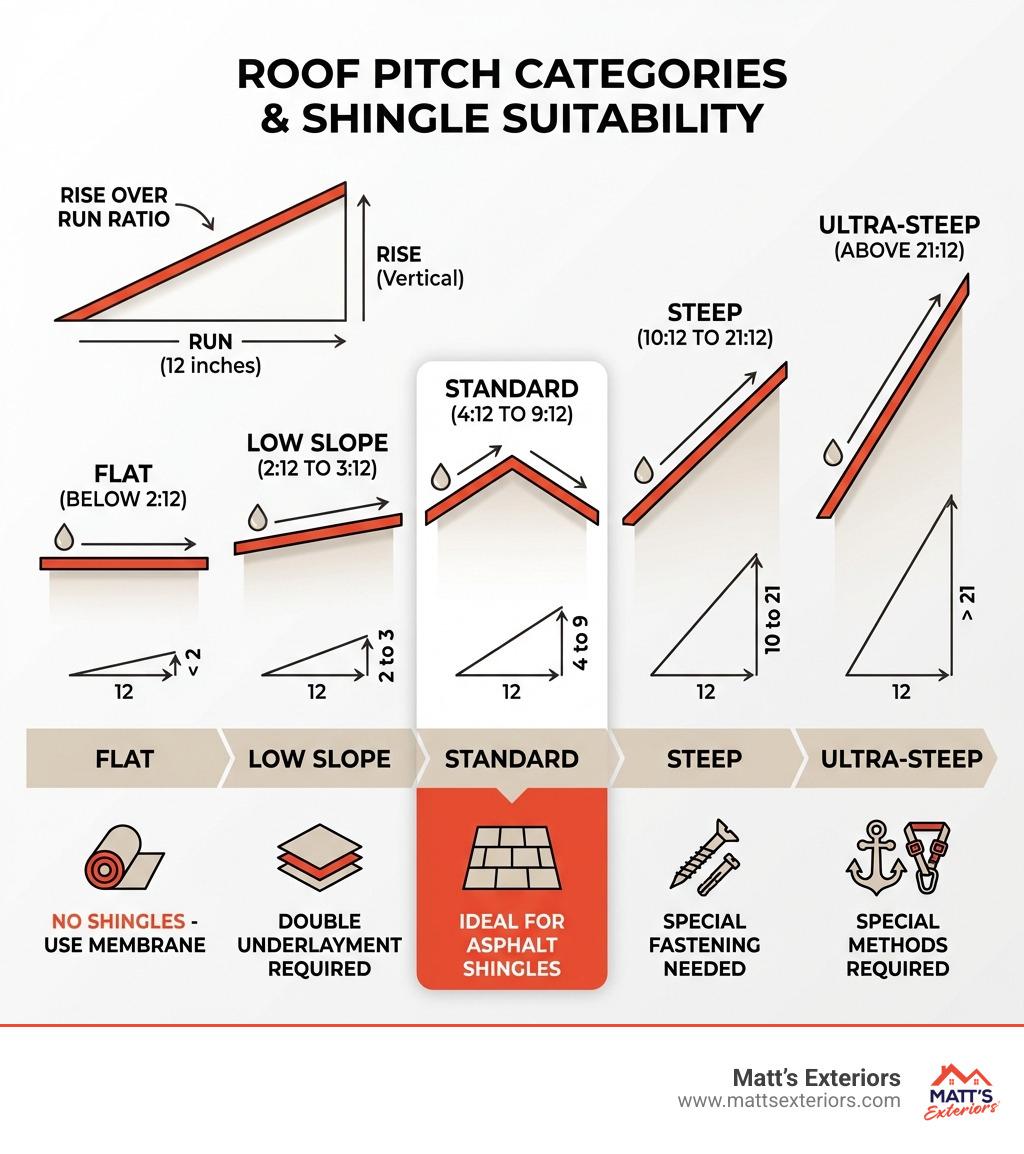
The best roof pitch for shingles falls between 4:12 and 9:12, with 4:12 being the widely accepted standard for a normal asphalt shingle installation and 6:12 often considered the sweet spot for drainage, longevity, and attic space.
Here's a quick-reference breakdown:
Pitch Range Category Shingle Compatible? Below 2:12 Flat No — use membrane 2:12 to 3:12 Low slope Yes, with double underlayment 4:12 to 9:12 Standard Yes — ideal range 10:12 to 21:12 Steep Yes, with special fastening Above 21:12 Ultra steep Special methods required
Asphalt shingles are water-shedding, not waterproof. They rely on gravity to move water off the roof. If the slope is too flat, water lingers — and that's when leaks start.
Most Metro Atlanta homes fall comfortably in the 4:12 to 9:12 range. But if you're replacing a roof, adding a dormer, or dealing with a low-slope porch section, pitch is the number you need to know before any material decisions get made.
Getting it wrong doesn't just cause leaks. It can void your shingle warranty entirely.
Before we dive into the nitty-gritty of asphalt shingles, we need to speak the same language. In the roofing world, "pitch" and "slope" are often used interchangeably, though they have slight technical differences. For most homeowners in Metro Atlanta, what matters is the ratio.
Roof pitch is expressed as a "rise over run" ratio. The "run" is always 12 inches (one foot). The "rise" is how many inches the roof goes up vertically over those 12 horizontal inches. So, if your roof rises 6 inches for every 12 inches it moves inward, you have a 6:12 pitch.
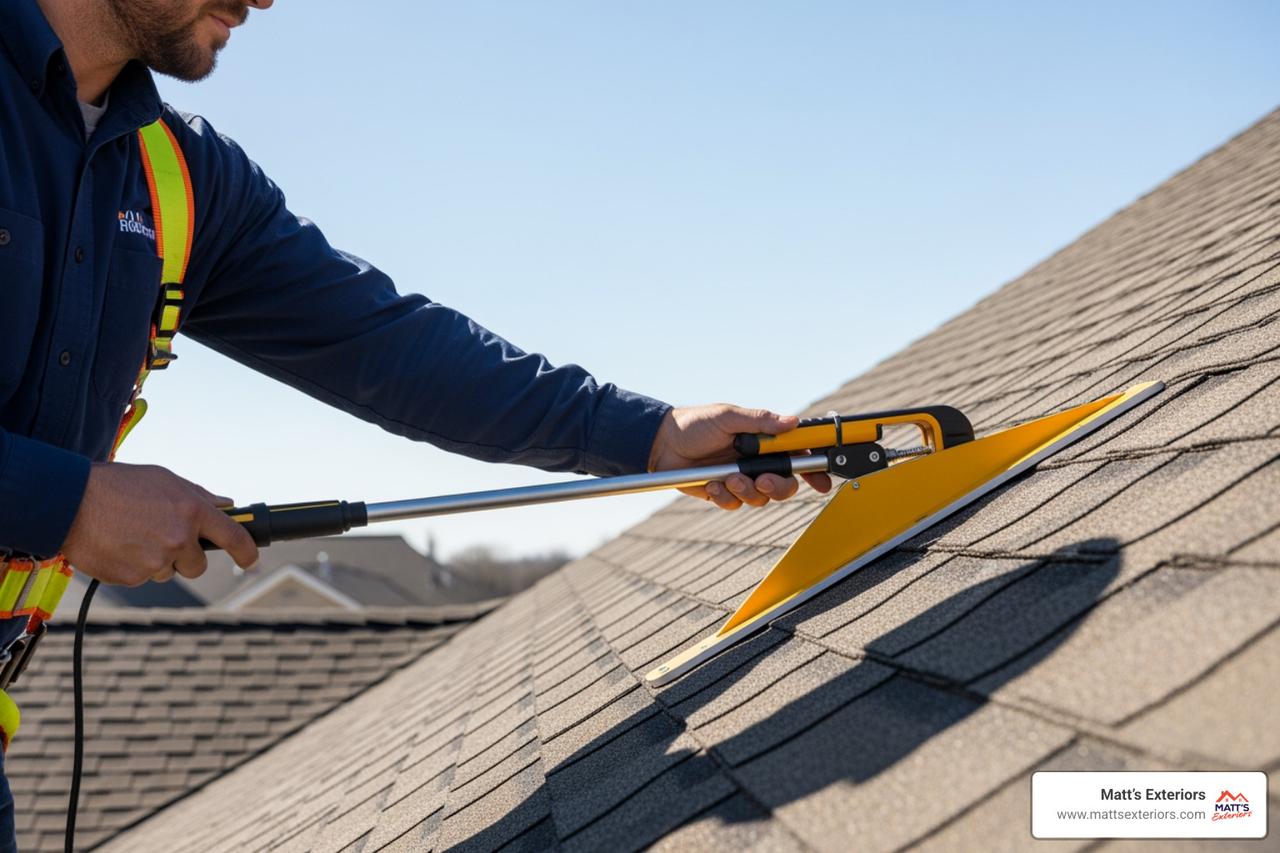
Measuring this accurately is vital because even a one-inch difference can change the building code requirements for your underlayment. If you are a fan of DIY tools, you can use this slope finder on Amazon or a simple online roof pitch calculator to do the math for you.
We always recommend staying off the roof if you aren't a trained professional with the right safety gear. Fortunately, there are ways to find your pitch without a ladder:
When we talk about the best roof pitch for shingles, we are looking for the "Goldilocks" zone—not too flat, not too steep. While modern shingles are incredibly durable, they are designed to work with gravity.
According to the International Building Code, the absolute minimum slope for asphalt shingles is 2:12. However, installing at this minimum comes with a massive list of "ifs" and "buts" regarding underlayment.
Historically, North American residential roofs have been built between 4:12 and 9:12. This range is considered "conventional" or "standard." Once you move above 9:12, you enter "steep slope" territory, and anything above 21:12 (which is very common on Victorian-style homes or Mansard roofs) requires specialized mechanical fastening because the shingles are practically standing vertical.
If we had to pick a "standard" winner, 4:12 takes the trophy. Why? Because at 4:12, the roof is steep enough to shed water effectively using standard underlayment methods, but it isn't so steep that it requires extra labor-intensive safety equipment or specialized fasteners.
A 4:12 pitch strikes a perfect balance:
Can a roof be too steep for shingles? Technically, no, but the rules change. The Asphalt Roofing Manufacturers Association (ARMA) considers 21:12 (about 60 degrees) the limit for "normal" application.
On ultra-steep slopes, gravity actually works against the shingle's adhesive strip. The shingles are so heavy and vertical that the factory-applied sealant might not "kick in" properly, especially in cooler weather. On these roofs, we have to use hand-sealing—applying quarter-sized spots of roofing cement under each tab—and use additional fasteners (usually 6 nails instead of 4) to ensure they don't slide off the house.
You might wonder, "If I like the look of a flat roof, why can't I just put shingles on it?" The answer lies in how shingles are made. They are overlapping pieces designed to let water "shingle" (slide) from one layer to the next.
When a roof is too flat, water doesn't slide; it sits. This leads to:
To understand how these pieces fit together, check out our guide on What Makes Up Your Roof? A Guide to the Components of a Roof.
While we don't get feet of snow every week in Metro Atlanta, we do get ice storms and occasional heavy snowfall in areas like Alpharetta and Woodstock. In regions prone to frozen precipitation, a steeper pitch is a lifesaver.
A 6:12 pitch or higher is recommended for shedding snow. Steeper roofs allow snow to slide off before it can melt and refreeze at the eaves, which is the primary cause of ice dams. For heavy rainfall—which we definitely get plenty of in Georgia—a pitch between 3:12 and 5:12 is usually sufficient for quick drainage, but 6:12 remains the practical standard for peace of mind.
Installing shingles on an improper pitch is like wearing snow tires in July—it's the wrong tool for the job. If the pitch is too low, you'll see:
If your home has a section—like a porch, a sunroom, or a "dead-flat" rear addition—that falls in the 2:12 to 4:12 range, you can still use shingles, but you can't install them the "standard" way. This is what the industry calls a "low-slope" application.
The International Residential Code (IRC R905.2.2) requires a double layer of underlayment for these slopes. Instead of one pass of felt or synthetic paper, we apply two layers, overlapping the sheets by 19 inches. This creates a secondary watertight barrier. In many cases, we recommend a full "Ice and Water" shield—a self-adhered membrane—across the entire low-slope surface for maximum protection.
For a deeper dive into these options, read our comparison on Rolled Roofing vs Shingles: What's Best for a Low Slope Roof.
Not all shingles look good on low slopes. Architectural (laminated) shingles are famous for their "shadow lines" and dimensional look. However, on a low-slope roof (like a 2:12), you can't really see those shadows from the ground.
In fact, some pros argue that traditional 3-tab shingles are a better aesthetic choice for very low slopes because they lie flatter and are more cost-effective for areas where the "curb appeal" of a high-definition shingle is lost. One critical rule we follow: never reduce the exposure (the amount of shingle visible) to try and make them "more waterproof." This messes up the nailing pattern and can actually cause more leaks.
Underlayment is the unsung hero of the low-slope roof. On a standard 6:12 pitch, the underlayment is a backup. On a 2:12 pitch, it is a primary defense.
We often use self-adhered membranes (leak barriers) at the eaves and valleys. These "stick" to the wood deck, sealing around every nail hole. This is "cheap insurance" against wind-driven rain that might get pushed sideways under the shingles during a heavy Georgia thunderstorm.
If your roof pitch is below 2:12 (less than 2 inches of rise per foot), shingles are no longer an option. At this point, the roof is considered "flat" in the eyes of a roofer.
For these areas, we switch to membrane systems:
If you are facing a full Roof Replacement and have sections with different pitches, we often design a "mixed" system—shingles for the main house and a matching membrane or metal for the flat sections.
Metal roofing is a fantastic alternative when you are right on the edge of the best roof pitch for shingles. While shingles struggle at a 3:12 pitch without extra help, a standing seam metal roof thrives there.
Metal panels can often be installed on slopes as low as 1:12 or even 1/4:12 depending on the seam type. Metal offers:
The absolute minimum is 2:12. Anything lower than that requires a flat-roof membrane system like TPO or EPDM. If you install shingles on a 1:12 pitch, they will leak, and your warranty will be void.
Yes, you can, but you must use a double layer of underlayment or a full self-adhered leak barrier across the entire deck. That from the ground, you won't see much of the shingle's texture because the angle is so shallow.
Yes, for two reasons. First, a steeper roof has more surface area than a flat one covering the same footprint (think of the Pythagorean theorem!). Second, labor costs are higher because our crews have to use specialized safety harnesses, scaffolding, and "roof jacks" to work safely on steep slopes.
Understanding the best roof pitch for shingles is about more than just numbers—it’s about protecting your home from the unique climate challenges we face here in Metro Atlanta. Whether you're in Marietta, Fayetteville, or Johns Creek, your roof's slope dictates exactly which materials will keep your family dry for the next 30 years.
At Matt’s Exteriors, we’ve seen it all across our 12,000+ projects. We know that a "one-size-fits-all" approach doesn't work when it comes to roof pitch. We pride ourselves on high-quality workmanship and using trusted materials that match your home's specific geometry.
If you’re worried that your roof might be too flat for shingles, or if you’re planning a Roof Replacement and want to ensure it's done right the first time, give us a call. We provide professional inspections to help you plan the perfect project for your home's unique "rise and run."