
Get Your Instant Quote Now!
Get Started
Composite doors exterior upgrades are one of the most popular home improvement decisions homeowners are making in 2026 — and for good reason. They combine the look of real wood with the durability of modern engineered materials, making them a strong choice for any exterior opening.
Here's what you need to know about composite exterior doors at a glance:
Feature What to Expect Material Layered construction — GRP skin, solid or foam core, composite frame Durability Resists rot, rust, warping, and insect damage Energy efficiency Insulated core reduces heating and cooling costs Security Multi-point locking, reinforced core, toughened glass Maintenance Low — occasional cleaning, no painting or sanding required Price range Starting around $398 for basic units; $800–$2,500 for mid-range; $5,000+ for premium custom Lead time Typically 6–16 weeks depending on customization
Whether you're replacing an aging wood door that warps every summer or upgrading a steel door that's starting to rust, a composite exterior door gives you a long-lasting, low-maintenance alternative that performs well in harsh climates — including Georgia's heat and humidity.
I'm Matt Lopez, founder of Matt's Exteriors, a Metro Atlanta exterior remodeling company serving homeowners since 2007 — and helping clients choose and install the right composite doors exterior is part of what we do every day. In this guide, I'll walk you through everything you need to know, from how these doors are built to what you should expect to pay.
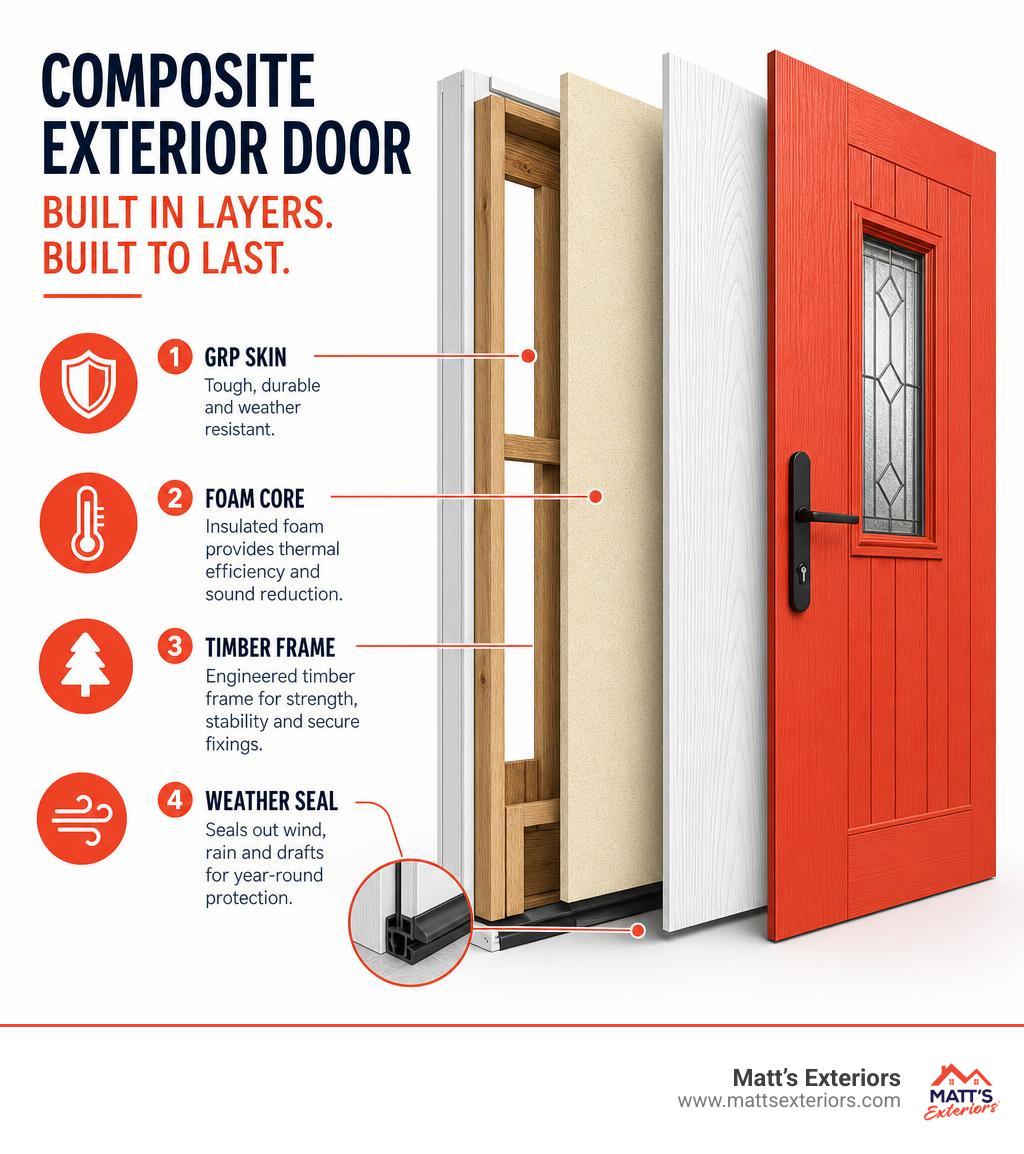
Composite exterior doors are entry doors made from several materials bonded together to create one stronger, more stable door system. Instead of relying on a single material like solid wood or steel, a composite door uses layers: a tough exterior skin, an insulated core, structural reinforcements, weather seals, and often a composite or PVC frame.
That layered design is the big idea. Each material does a job:
Most composite exterior doors are sold as prehung systems, meaning the slab comes already fitted inside a frame. That matters because a door is only as good as the system around it. A great slab in a poor frame is like buying premium tires and forgetting to tighten the lug nuts. It will not perform the way it should.
Composite doors are commonly used for front entry doors, back doors, side doors, and some patio door systems. Many are designed to look like painted wood or stained woodgrain, but they avoid many of the problems that come with real wood in humid climates.
Every exterior door material has tradeoffs. The right choice depends on your budget, style, exposure, security needs, and how much maintenance you want to deal with.
Door Material Strengths Weaknesses Best Fit Composite Resists rot, rust, warping, dents, insects, and moisture; good insulation; many styles Higher upfront cost than basic steel or uPVC; quality varies Homeowners wanting long-term value and low maintenance Wood Classic appearance, highly customizable, premium feel Can warp, rot, swell, crack, and require regular finishing Covered entries and historic homes where wood is preferred Fiberglass Durable, insulated, wood-look options, low maintenance Lower-end models can crack; premium models can be expensive Energy-conscious homeowners wanting wood style without wood upkeep Steel Strong, often budget-friendly, secure with good hardware Can dent, rust if coating fails, conducts heat/cold more than insulated composite Budget projects and utility entries uPVC Low maintenance, moisture resistant, usually affordable Can look less premium; may expand/contract; limited upscale styles Back doors, side entries, and budget-conscious replacements
Composite and fiberglass are closely related in many product categories. In fact, some “fiberglass” doors are marketed as composite because they use a fiberglass or GRP outer skin with an engineered core. GRP stands for glass reinforced plastic, a tough molded material used on many composite door faces.
Compared with wood, composite doors usually win on moisture resistance and maintenance. Compared with steel, they usually win on dent resistance and rust resistance. Compared with basic uPVC, they usually offer a more substantial feel, better style options, and better front-entry curb appeal.
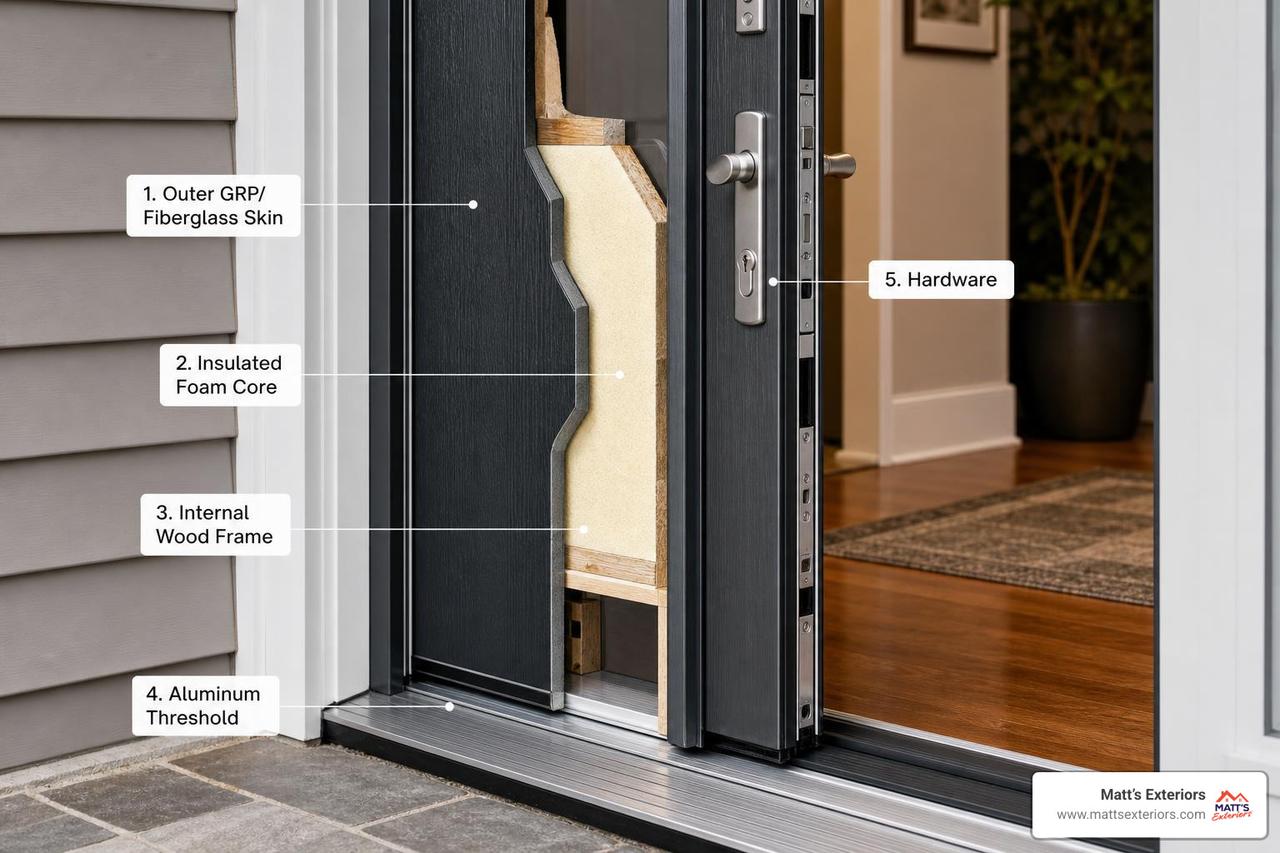
A composite exterior door may look simple from the street, but the inside is doing a lot of work.
Common components include:
Some timber-like composite systems use detailed layered construction, such as thick laminated cores and exterior skins designed to mimic wood. You can see an example of this type of construction in this timber-like composite construction example.
The key takeaway: not all composite doors are built the same. A light-duty slab with basic weatherstripping is very different from a reinforced prehung entry system with an insulated core, quality threshold, and multi-point locking.
In Metro Atlanta, an exterior door has to deal with hot summers, humidity, heavy rain, pollen, sun exposure, and the occasional cold snap. That is a lot to ask from one rectangle on hinges.
Composite exterior doors are popular because they are engineered for those conditions. They do not absorb moisture like wood, they do not rust like steel, and they are less likely to swell or twist when the weather changes.
A well-made composite exterior door is built to resist:
This is especially important at front entries that get direct sun or side entries with little roof protection. Wood doors can expand and contract as moisture levels change. Steel doors can rust if scratches expose bare metal. Composite doors avoid many of those problems because the outer skin and core are engineered to stay stable.
That does not mean composite doors are indestructible. Lower-quality doors can still fade, crack, or lose finish quality over time. Hardware can loosen. Weatherstripping can compress. Thresholds can wear. But as a category, composite doors are one of the more durable exterior door choices available in 2026.
Warranty coverage is worth reviewing carefully. Some door systems offer long warranties on the slab, shorter coverage on finishes, and separate terms for glass, hardware, or frames. Read the warranty like you would read a recipe before cooking for guests. The small details matter.
Energy efficiency is one of the biggest reasons homeowners choose composite exterior doors. The insulated core helps reduce heat transfer, while quality weatherstripping helps stop air leaks.
Important efficiency features include:
A door’s U-value measures how well it prevents heat transfer. Lower U-values generally mean better insulation. Some high-performance composite doors list specific U-values, while others provide ENERGY STAR or manufacturer performance data.
For homes in Atlanta, Alpharetta, Marietta, Peachtree City, Newnan, Roswell, Sandy Springs, and surrounding Metro Atlanta communities, air sealing is just as important as the slab itself. A high-quality door installed out of square can leak air around the frame and cancel out much of the energy benefit.
If your current entry door has daylight around the edges, a warm draft in summer, or cold air in winter, the door system may be costing you comfort and energy. You can learn more about available entry options through our exterior door installation options.
A composite exterior door can be very secure, especially when paired with the right frame and hardware.
Security features to look for include:
Multi-point locks secure the door at more than one location, often at the top, middle, and bottom. This can make the door feel tighter when closed and more resistant to forced entry than a basic latch-only setup.
Glass matters too. Decorative glass can be beautiful, but for security and privacy, look for toughened, laminated, or insulated glass units. If the door has sidelites, those should also be selected with security in mind.
Soundproofing is another benefit. Composite doors with insulated cores and tight seals can reduce street noise, barking dogs, traffic hum, and general neighborhood sound. They will not turn your foyer into a recording studio, but they can make the entry feel quieter and more comfortable.
One of the best things about composite exterior doors is that they are practical without looking boring. Today’s options include traditional panel doors, modern flush designs, Craftsman styles, arched tops, glass inserts, sidelites, bold colors, and wood-look finishes.
In other words, your door can stop acting like a background character and finally get a little main-character energy.
Composite doors are available for several exterior openings, including:
For front doors, homeowners often choose decorative panels, glass inserts, sidelites, or statement colors. For back doors, durability, privacy, and easy cleaning may matter more. For patio doors, glass area, energy performance, and smooth operation become priorities.
Composite patio door systems may include fixed panels, operating panels, Low-E glass, argon gas, and even blinds between glass in some designs. If you are exploring wider openings or patio transitions, our guide to folding exterior door ideas is a helpful next read.
Glass can completely change how a door feels. A solid door offers maximum privacy, while a full-lite or half-lite door brings in natural light. Many homeowners choose something in the middle: enough glass to brighten the entry, but not so much that the delivery driver can evaluate your shoe collection.
Common glass options include:
Frosted and obscure glass are great choices for front entries, bathrooms, side doors, and any opening where privacy matters. For design inspiration, see our guide to frosted exterior glass ideas.
Composite entry systems can also include one or two side panels, sometimes called sidelites or side screens. These add width, daylight, and curb appeal. Here is a composite door with side screen example that shows how glass and side panels can change the look of an entry.
Composite exterior doors are low maintenance, not no maintenance. The difference matters.
A simple care schedule looks like this:
Task How Often What to Do Clean the slab Every 2-3 months Use mild soap, water, and a soft cloth Rinse pollen and dirt As needed Avoid pressure washing close to seals Check weatherstripping Twice a year Look for gaps, cracks, or flattened seals Lubricate hinges and locks Once or twice a year Use manufacturer-approved lubricant Inspect finish Annually Look for fading, scratches, or chips Check threshold and drainage Annually Keep weep holes and sill areas clear Adjust hardware As needed Tighten loose screws and check latch alignment
Avoid abrasive cleaners, harsh solvents, steel wool, and aggressive pressure washing. If the door has a factory finish, follow the manufacturer’s cleaning instructions so you do not void coverage.
Most composite doors do not need sanding, staining, or repainting like wood. Some can be repainted if you want a new color later, but that depends on the door skin and finish system. Always check before grabbing a brush and declaring a weekend project.
Composite exterior door prices vary widely. As of May 2026, basic composite or fiberglass-composite exterior doors can start around $398.40, while mid-range doors commonly fall between $800 and $2,500 depending on size, glass, hardware, and finish. Premium custom systems with sidelites, upgraded glass, special colors, or oversized dimensions can exceed $5,000.
Lead times also vary. Standard models may be available sooner, while custom composite door systems can take 6-16 weeks depending on the manufacturer, options, and shipping.
Here is a practical 2026 cost breakdown:
Door Type Typical Price Range What Affects Cost Basic composite/fiberglass-composite slab or unit About $398-$800+ Standard size, minimal glass, basic finish Mid-range composite exterior door About $800-$2,500 Better core, prehung frame, glass, color options Premium or custom composite entry $2,500-$5,000+ Sidelites, decorative glass, custom size, high-end hardware Large custom systems $5,000+ Double doors, side panels, specialty shapes, premium finishes
Installation is separate unless included in a package. Labor can vary based on the condition of the existing frame, whether the opening needs repair, whether trim must be replaced, and whether the door is standard or custom-sized.
Composite doors can be cost-effective over time because they reduce maintenance, improve comfort, and typically last longer than doors that struggle with rot, rust, or warping. The cheapest door is not always the least expensive door after 10 years. Sometimes it is just the first payment on a future headache.
Homeowners can buy composite exterior doors from several sources:
Large national catalogs may show anywhere from a small number of composite door options to well over 1,000 listings, but availability, sizing, and installation support vary. A door that looks perfect online may not be the right fit for your opening, exposure, or local building requirements.
Before buying, check:
For Metro Atlanta homeowners, working with a local exterior team can help avoid ordering mistakes and performance issues. At Matt’s Exteriors, we look at the full opening, not just the door slab, because the frame, flashing, threshold, and trim all affect long-term performance.
Installation can make or break a composite exterior door. A premium door installed poorly can leak, stick, drag, or fail early.
Important installation details include:
Prehung units are often the best choice for replacement projects because the slab and frame are designed to work together. If you are comparing budget options, our guide to cheap exterior doors with frames explains why frame-included systems can be a smart value.
Permits are not always required for a straightforward door replacement, but requirements can vary by city, HOA, project scope, and whether structural changes are involved. This applies throughout Metro Atlanta communities such as Atlanta, Cumming, Duluth, Dunwoody, Fayetteville, Johns Creek, Kennesaw, McDonough, Norcross, Smyrna, Suwanee, Woodstock, and nearby areas.
Below are the questions we hear most often from homeowners comparing composite doors with wood, steel, fiberglass, and other exterior door options.
Yes, composite exterior doors are often worth it long term for homeowners who want durability, energy efficiency, security, and curb appeal without constant maintenance.
They are especially valuable if your current door has problems such as:
The long-term value comes from total ownership cost. A composite door may cost more upfront than a basic steel door, but it can save money and frustration by reducing maintenance, improving comfort, and lasting longer in humid conditions.
They can also improve resale appeal. A front door is one of the first things people notice, and a clean, secure, well-fitted entry makes the whole exterior feel better maintained.
Composite doors have many strengths, but they are not perfect. The main disadvantages include:
Most of these issues can be reduced by choosing a quality door system and having it professionally installed.
Yes, composite exterior doors can be budget-friendly if you make smart choices.
To control cost, consider:
If budget is your top concern, start with our cheap exterior doors guide. If your opening is a common size, our 32x80 exterior door guide can help you understand what to expect from that category.
The goal is not to buy the cheapest door possible. The goal is to buy the best door your budget allows without sacrificing the parts that matter most: fit, weather resistance, security, and installation quality.
Composite exterior doors are a strong long-term choice for many Metro Atlanta homeowners. They combine the look of wood, the durability of engineered materials, solid insulation, strong security options, and low maintenance. For Georgia’s heat, humidity, rain, and seasonal temperature swings, that combination makes a lot of sense.
The best composite door is not just the prettiest one in the catalog. It is the one that fits your opening, matches your home, handles your weather exposure, meets your privacy needs, and is installed correctly.
At Matt’s Exteriors, we are a family-owned exterior renovation company serving Metro Atlanta with high-quality workmanship, trusted materials, and exceptional customer care. Since 2007, we have completed over 12,000 projects, and we would be glad to help you choose an exterior door that looks great and performs for years.
Ready to compare styles, materials, and installation options? Start here: explore exterior door installation options.