
Get Your Instant Quote Now!
Get Started
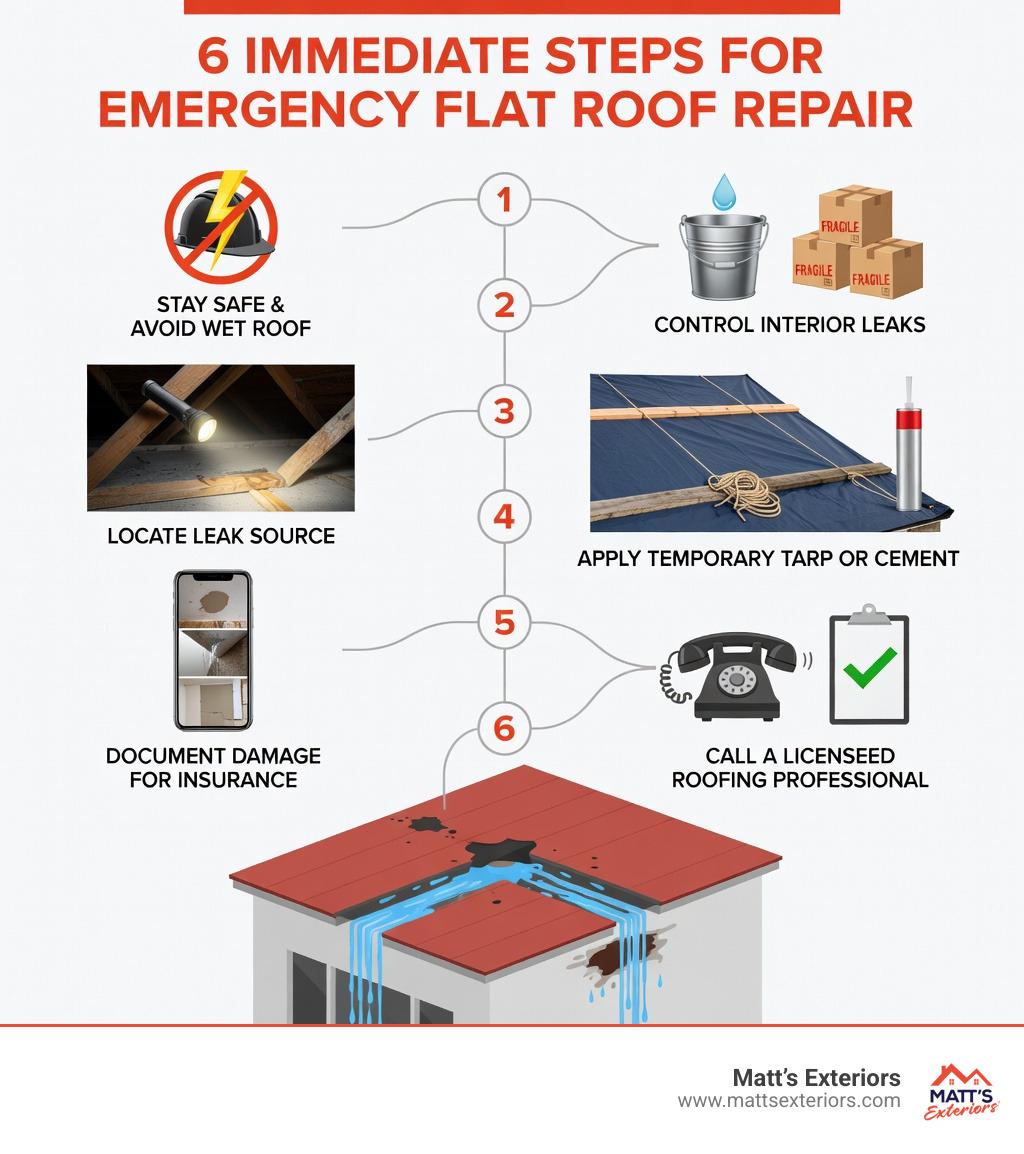
Emergency flat roof repair is needed when water is actively entering your home and every minute of delay means more damage to your ceilings, walls, and belongings.
Here are the immediate steps to take:
Flat roofs are especially vulnerable because water has nowhere to drain quickly. Even a small puncture or failed seam can let in a steady stream during heavy Atlanta rain. And once water gets past the membrane, it travels - so the drip you see inside your home may be several feet away from the actual entry point.
The good news: most flat roof emergencies can be stabilized quickly with the right materials and approach. This guide walks you through exactly how.
In our years of serving Metro Atlanta—from the busy streets of Marietta to the quiet neighborhoods of Peachtree City—we’ve seen that homeowners often wonder: "Is this a 'call now' emergency or a 'wait until Monday' problem?"
A true emergency flat roof repair situation is any scenario where the structural integrity of your home is at risk or where water is causing active, ongoing damage. If you see water ponding for more than 48 hours after a Georgia thunderstorm, that is a major red flag. Ponding water is heavy; it degrades the membrane and can eventually lead to a collapse if the decking underneath has rotted.
Other signs that require immediate action include:
To understand how these parts work together, you can check out our guide on What Makes Up Your Roof: A Guide to the Components of a Roof. For immediate protection tips, Emergency Roof Protection offers excellent baseline advice on mitigating damage.
Before we even talk about patches or tarps, we have to talk about safety. We’ve completed over 12,000 projects since 2007, and the reason we’re still here is that we never cut corners on safety. If you are attempting a DIY temporary fix in a place like Alpharetta or Sandy Springs, you must be incredibly careful.
Safety First Checklist:
For more resources on professional safety protocols, visit Emergency Roofing Solutions: Home.
If you’ve identified the leak and it’s safe to be on the roof, you can buy yourself some time. These are temporary fixes. As we like to say, a "Band-Aid" fix might last a few weeks, but it won’t survive a full Georgia summer of UV rays and heat.
The type of repair you use depends on your roof material. Most flat roofs in our area are either EPDM (black rubber), TPO (white/grey plastic), or Modified Bitumen (rolled asphalt).
Material Type Best Emergency Fix Pros Cons EPDM (Rubber) Peel-and-stick patches Very easy to apply; forgiving material Surface must be bone-dry and clean TPO / PVC TPO-specific tape High reflectivity Requires specialized tape; standard cement often fails Modified Bitumen Roofing cement & mesh Durable; handles "wet patch" products well Messy; can crack over time
For a deeper dive into how these materials compare, see our article on Rolled Roofing vs Shingles: What's Best for a Low Slope Roof.
If the damage is too large for a patch—say a large tree limb fell on your roof in Dunwoody—a tarp is your best bet.
When disaster strikes in places like Johns Creek or Cumming, the first question is usually: "How much is this going to cost?"
In the Metro Atlanta area, emergency flat roof repair costs typically range from $500 to $5,000.
Factors affecting your price:
Will Insurance Cover It?Most homeowners' insurance policies cover roof damage caused by "unpreventable" events like wind, hail, or fallen trees. However, they rarely cover damage caused by "neglect" (like a 30-year-old roof that simply wore out).
To protect your claim:
If the damage is extensive, you might be looking at a Roof Replacement, which is a larger investment but comes with long-term warranties (sometimes up to 50 years!).
A flat roof emergency is any situation where water is actively entering the living space or the structural integrity of the building is threatened. This includes heavy interior leaks, large sections of membrane being blown off by wind, fire damage, or structural sagging. If you have a "waterfall" in your kitchen after a storm in Smyrna, that's an emergency. If you just noticed a small water stain that hasn't grown in three months, that's a standard repair.
As mentioned, most local repairs fall between $500 and $5,000. For a standard one-story home in the Atlanta suburbs, expect to pay a minimum of $499 for a professional to come out, assess the damage, and apply a high-quality temporary fix. The final cost depends on the complexity—fixing a leak around a complex HVAC unit on a roof is much harder than patching a hole in the middle of a flat membrane.
We strongly advise against it. Flat roofs are incredibly slippery when wet. Furthermore, most sealants and tapes will not bond to a surface while water is actively flowing over it. Your best bet during a storm is to manage the water inside your home with buckets and tarps. Once the rain stops, you can safely head up to apply a "wet-patch" cement or a tarp.
Dealing with a roof leak is stressful, but you don't have to handle it alone. Whether you're in Woodstock, Fayetteville, or anywhere in between, Matt’s Exteriors is here to help. We are a family-owned company that has called Metro Atlanta home for years, and we pride ourselves on high-quality workmanship and trusted materials.
Temporary fixes are great for stopping the immediate "drip-drip-drip" on your forehead, but they aren't a permanent solution. To ensure your home stays dry through the next decade of Georgia's wild weather, you need a professional touch.
Don't wait for the next storm to turn a small leak into a major renovation. More info about our professional roofing services is just a click away. Give us a call, and let’s get your flat roof back in tip-top shape!