
Get Your Instant Quote Now!
Get Started
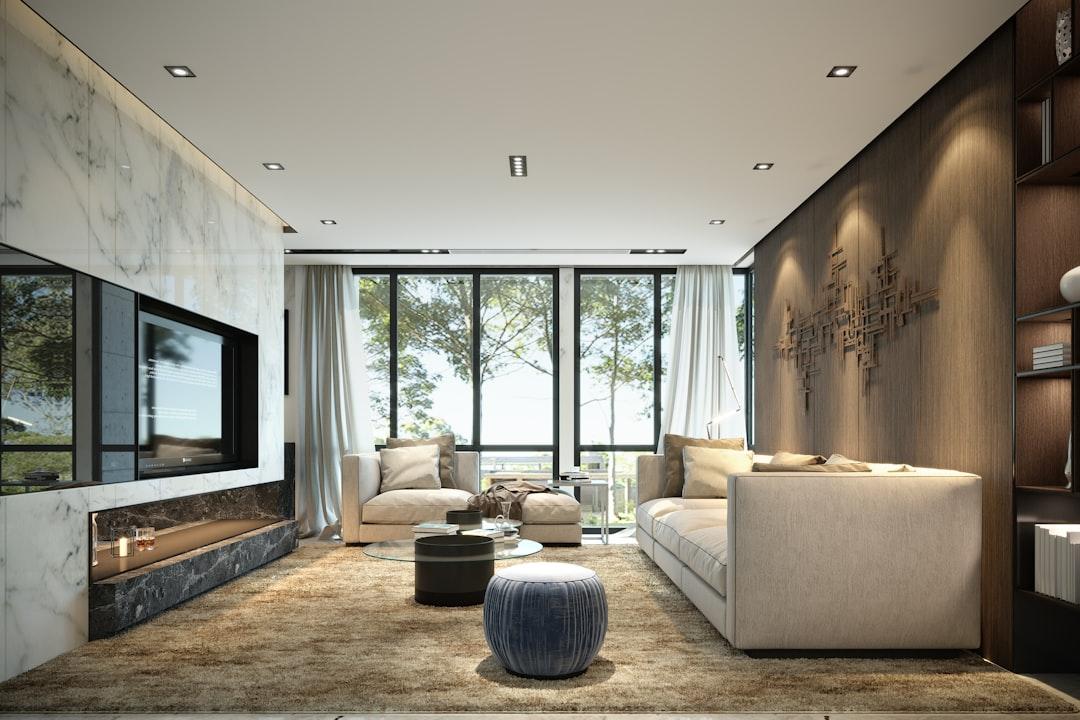
A skylight fixed in your roof can dramatically transform your home, bringing in natural light and enhancing its overall appeal. If you're wondering what makes fixed skylights a smart choice for your Metro Atlanta home, here’s a quick overview:
Fixed skylights offer a simple yet powerful way to brighten your home and improve your daily living. They bring the beauty of the outdoors inside, discreetly and efficiently.
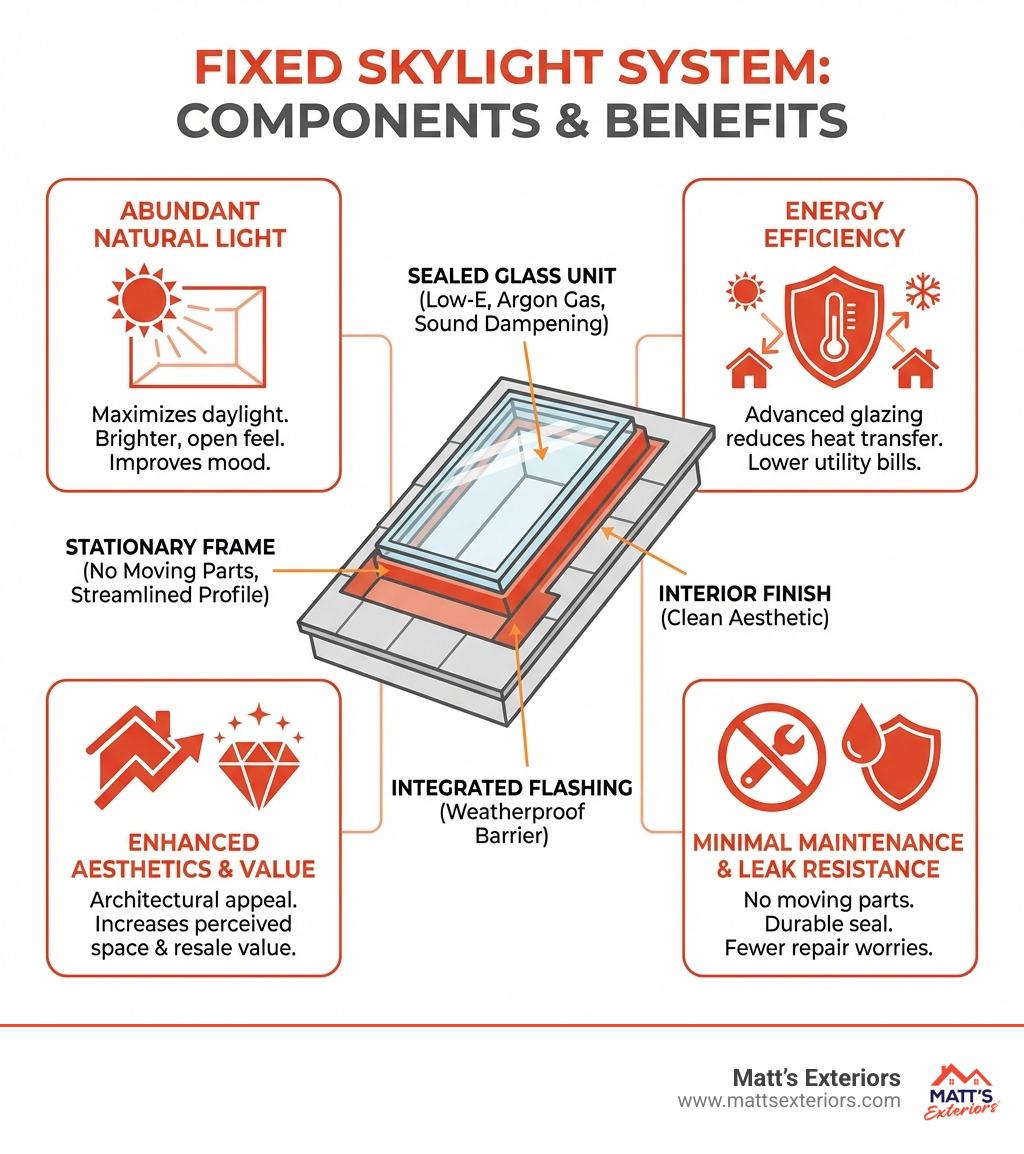
When we talk about a skylight fixed into a roof, we are referring to a stationary window that is designed primarily to provide natural light rather than ventilation. Unlike venting or "operable" skylights, which can be opened manually or via an electric motor to let in fresh air, a fixed model is sealed shut.
In the roofing world, we often say that if you don't need the breeze, go with the "freeze"—meaning a fixed unit. Because they don't have hinges, chains, or opening mechanisms, they offer a much more streamlined, minimalistic profile on your roofline. This makes them a favorite for homeowners in areas like Marietta or Alpharetta who want the aesthetic boost of a window to the stars without the mechanical complexity of a venting unit.
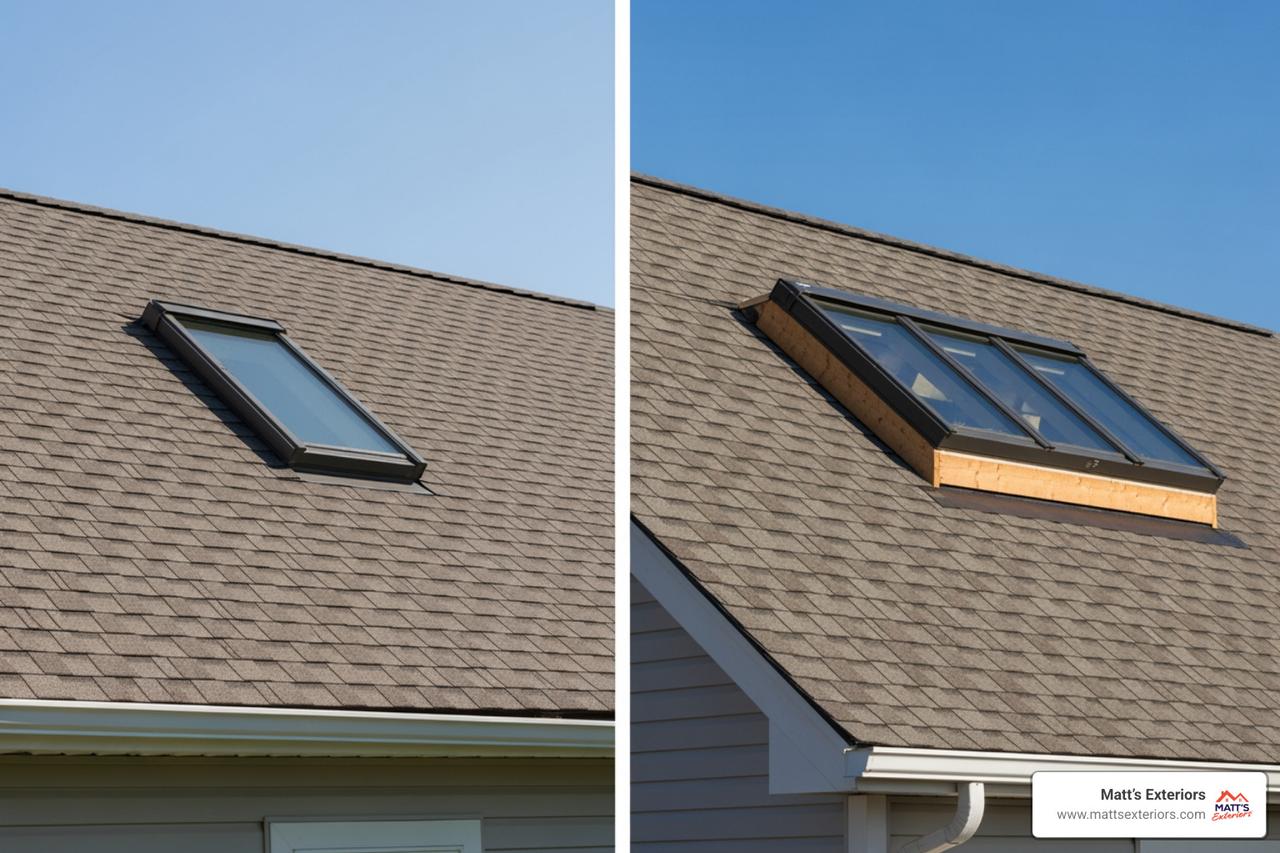
There are three primary ways these units are mounted to your home:
You also have choices in glazing. While acrylic (plastic) domes are common in older commercial applications, most modern residential installations use high-performance glass. Glass is clearer, quieter, and lasts much longer without yellowing or scratching. For more details on the specific types we offer, check out our Skylight service page.
The most common question we hear from homeowners in Peachtree City or Cumming is: "Why wouldn't I want one that opens?" While fresh air is great, a skylight fixed in place offers several distinct advantages:
Getting the right fit is crucial. In the industry, we look at two main sets of numbers: the "Rough Opening" (the hole cut in your roof) and the "Outside Frame" dimensions.
Standard sizes often follow common rafter spacing. You’ll frequently see widths like 14-1/2 inches (to fit between 16-inch on-center rafters) or 22-1/2 inches (for 24-inch on-center rafters). Common lengths include 30-1/2, 46-1/2, and even up to 70-1/2 inches for those dramatic, floor-to-ceiling light wells. If your home has unique architectural needs, custom sizes are always an option to ensure a perfect fit.
Beyond just looking "cool," a fixed skylight serves a functional purpose for your health and your home's atmosphere. Imagine a small bathroom or a dark corridor in a ranch-style home in Kennesaw. Adding a skylight creates an "expansion" effect, making the room feel twice as large simply by removing the visual boundary of a dark ceiling.
Natural light is a powerful medicine. It helps regulate our circadian rhythms, which are the internal clocks that tell us when to sleep and when to wake up. Exposure to daylight also boosts serotonin levels and helps our bodies produce Vitamin D. If you're curious about how a specific room might look, you can Visualize your skylight with this AR app to see the transformation before we even pick up a hammer.
In many Metro Atlanta neighborhoods, houses are built close together. Standard windows often mean choosing between natural light and your privacy. A skylight fixed in the ceiling provides a view of the clouds and the stars without giving the neighbors a view of your living room.
Feature Fixed Skylight Venting Skylight Primary Purpose Natural Light Light + Airflow Leak Risk Very Low Low (if maintained) Price Point Budget-Friendly Premium Maintenance Minimal Periodic Energy Seal Permanent Mechanical
We’ve come a long way from the single-pane glass of the 1970s. Modern units are high-tech energy savers. Most quality fixed skylights today use double or even triple glazing. The space between the panes is filled with Argon gas, which acts as a powerful insulator.
When shopping, look for two key numbers:
Many of the models we install are ENERGY STAR rated, meaning they meet strict government standards for efficiency in our specific climate zone.
If you live near a busy road in Buckhead or Sandy Springs, you’ll appreciate the sound dampening of a skylight fixed with laminated glass. High-quality glass units can reduce outside noise by up to 25% compared to standard double-pane windows and up to 50% compared to plastic domes.
Additionally, modern "LoE3" glass coatings block up to 95% of harmful UV rays. This is vital for protecting your hardwood floors, expensive rugs, and furniture from the "sun bleaching" that occurs with unfiltered light.
Installing a skylight isn't as simple as cutting a hole and dropping in a window. It requires a deep understanding of your roof's anatomy. For instance, most glass skylights require a minimum roof pitch of 2:12 or 3:12 to ensure that water sheds properly and doesn't pool on the glass.
The most critical component of the installation is the flashing system. This is the metal "armor" that surrounds the skylight and directs water away from the opening. We use advanced step-flashing and adhesive underlayments to provide dual layers of water protection. To understand how this fits into your overall roofing system, read our guide on What makes up your roof: A guide to the components of a roof.
In the Metro Atlanta area—from Fayetteville to Woodstock—we deal with intense humidity and sudden, heavy thunderstorms. A skylight fixed properly must be "thermally broken." This means the frame is designed to prevent the humid outside air from meeting the cool inside air, which is the primary cause of condensation and "sweating" on the glass.
Our local climate also demands impact resistance. Georgia is no stranger to hail and falling tree limbs. Choosing a unit with tempered or laminated safety glass ensures that if an object does hit the skylight, it won't shatter into dangerous shards inside your home.
While big-box stores sell skylights to the general public, this is one project where "doing it yourself" can be a very expensive mistake. Because a skylight involves cutting through the structural rafters and the waterproof barrier of your roof, the margin for error is zero.
Professional installation ensures:
If you’re ready to see what professional installation looks like, visit our Services page.
The cost of a skylight fixed in your roof varies based on the complexity of the project. A simple replacement of an existing unit might range from $2,000 to $3,600. However, a brand-new installation—which involves cutting the roof, framing the "light shaft" through the attic, and finishing the drywall inside—typically ranges from $2,800 to $5,000.
The Return on Investment (ROI) isn't just financial; it's emotional. However, from a resale perspective, homes that are bright and "airy" consistently sell faster and for higher prices in the Atlanta market. Buyers love the "HGTV" look that natural light provides.
Even though they are low-maintenance, they aren't "no-maintenance." We recommend:
You can further enhance your skylight fixed system with accessories like solar-powered shades. These shades are fantastic because they:
Actually, it's the opposite! Because a skylight fixed in place is factory-sealed and has no moving parts or mechanical seals that can wear down, it is the most watertight option available. Most leaks reported by homeowners are actually caused by poor flashing around the unit, not the skylight itself.
If your roof is safely accessible, you can clean it with a soft cloth and mild soap. However, most homeowners prefer using a telescopic window cleaning pole. If your skylight features "Neat" or "Clean" glass technology, it stays virtually spotless by using the sun’s rays to decompose organic dirt.
Yes! Under current federal guidelines, many ENERGY STAR certified skylights—especially those with solar-powered components like integrated shades—qualify for a federal tax credit. This can significantly offset the cost of the installation.
At Matt’s Exteriors, we’ve spent years helping homeowners across Metro Atlanta—from the quiet streets of Senoia to the bustling neighborhoods of Dunwoody—bring more light into their lives. As a family-owned company with over 12,000 projects under our belt since 2007, we know exactly what it takes to ensure your skylight fixed in the roof remains a source of joy, not a source of leaks.
We pride ourselves on high-quality workmanship, using only trusted materials like VELUX, and providing exceptional customer care. Whether you are in Smyrna, Johns Creek, or McDonough, we are here to help you transform your home.
Ready to brighten up your living space? Schedule your skylight consultation with us today and let’s get your home ready to shine!