
Get Your Instant Quote Now!
Get Started
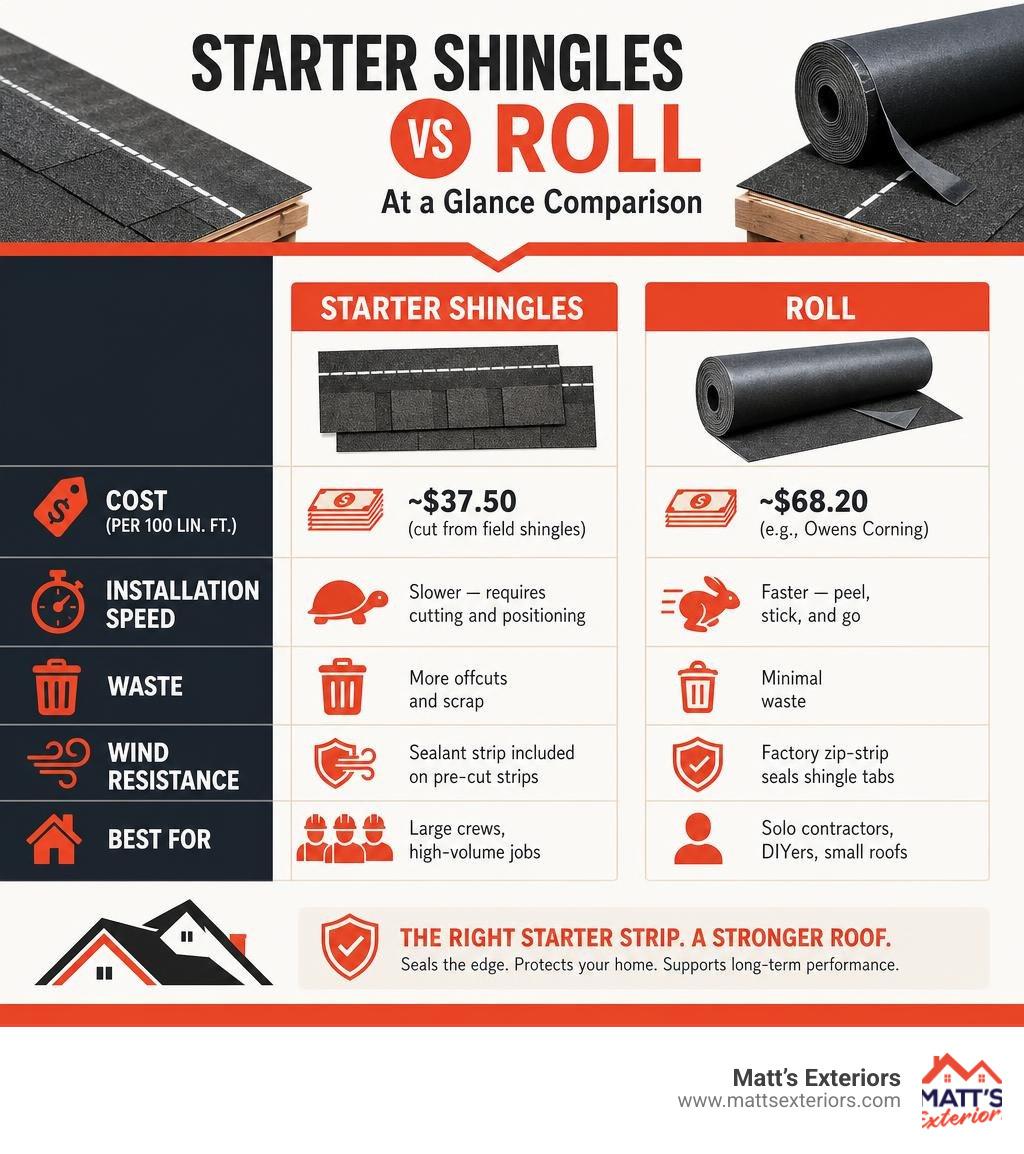
When comparing starter shingles vs roll, here is a quick answer:
Starter Shingle Bundles Starter Rolls Form Pre-cut flat strips or cut from field shingles Continuous self-adhering roll Cost (per 100 lin. ft.) ~$37.50 (cut from field shingles) ~$68.20 (e.g., Owens Corning) Installation Speed Slower — requires cutting and positioning Faster — peel, stick, and go Waste More offcuts and scrap Minimal waste Wind Sealing Sealant strip included on pre-cut strips Factory zip-strip seals shingle tabs Best For Large crews, high-volume jobs Solo contractors, DIYers, small roofs
Most homeowners never think twice about starter strips. They are hidden under the first row of shingles, so they are easy to overlook. But they do a critical job — sealing the roof edge against wind and water.
Choose the wrong method, or skip them entirely, and you risk shingle blow-off, leaks at the eaves, and a voided manufacturer warranty.
The choice between starter shingle bundles and starter rolls is not always obvious. Material cost, labor time, roof size, crew size, and local building codes all play a role. What works well for a large roofing crew may not be the smartest choice for a solo DIYer on a weekend project — and vice versa.
This guide breaks it all down so you can make a confident, informed decision before your next roof installation or replacement.
I'm Matt Lopez, founder of Matt's Exteriors, a GAF-certified roofing contractor serving Metro Atlanta since 2007 with nearly two decades of hands-on experience helping homeowners navigate decisions just like the starter shingles vs roll debate. Whether you're managing a full roof replacement or a targeted repair, the guidance in this article reflects real-world installation experience across hundreds of residential roofs throughout Fayette, Coweta, and surrounding counties.
Before we dive into the nitty-gritty comparison of starter shingles vs roll, let's define what these products actually are and why they are indispensable.
When we install a roof, we don't just start nailing down standard shingles at the very edge. If we did, water would seep directly through the joints of that first row and rot the roof sheathing beneath. To prevent this water penetration, we must install a continuous waterproof barrier directly along the eaves and rake edges. This barrier is the starter course.
The starter course serves two main purposes:
To learn more about how this component fits into the larger picture of your roofing system, check out our guide on What Makes Up Your Roof: A Guide to the Components of a Roof.
Traditionally, roofers created starter shingles by taking standard three-tab shingles and cutting the tabs off with a utility knife, or taking architectural shingles and trimming away the headlap. This left a flat, rectangular strip with an adhesive line that could be nailed along the eave.
While cutting individual starter shingles from field shingles is still common, manufacturers now offer engineered, pre-cut starter strips. Products like the Starter Strip Plus Shingle are designed to eliminate the tedious chore of manual cutting.
These pre-cut strips come in bundles, lay flat, and are sized specifically to match modern architectural shingles. They feature a continuous line of heavy-duty adhesive positioned exactly where it needs to be to bond with your starter row, saving valuable prep time on-site.
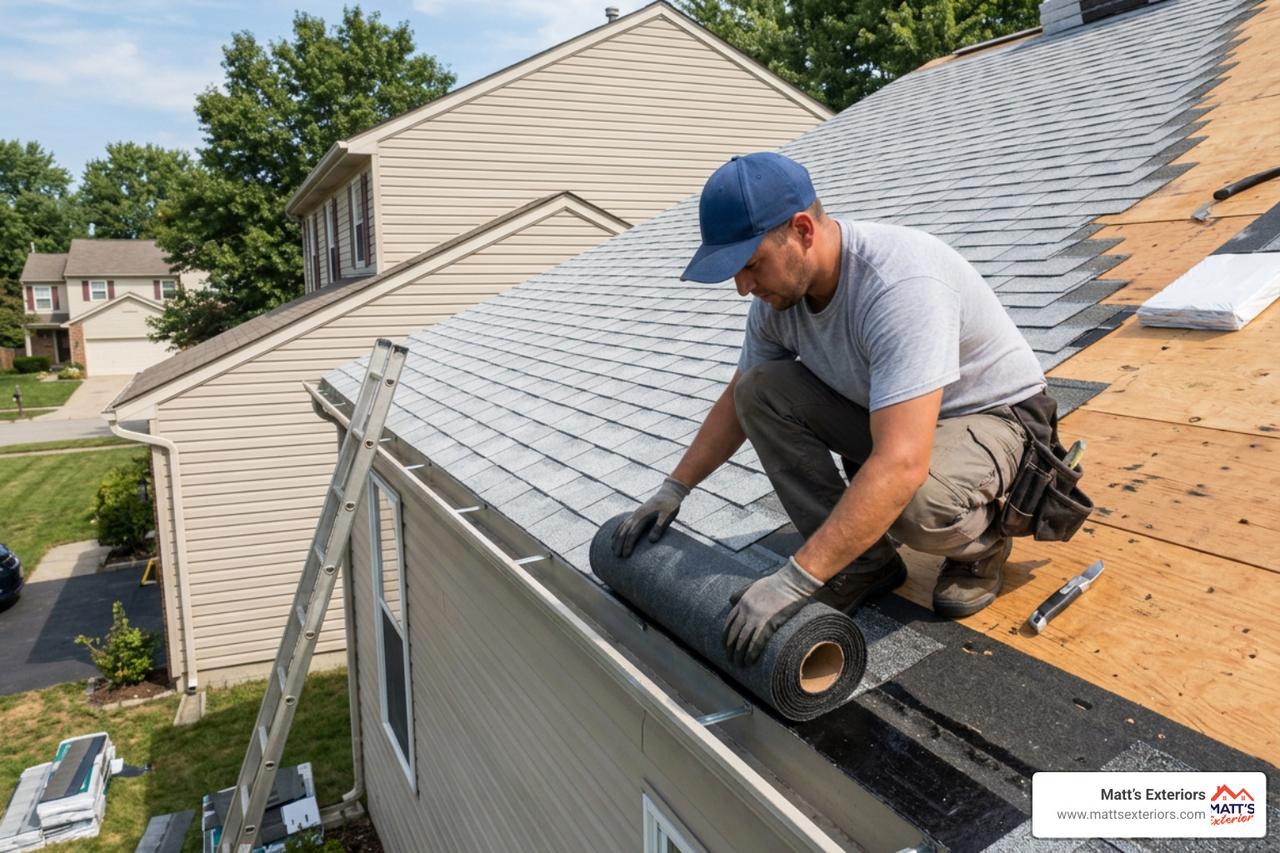
A starter shingle roll is a modern, self-adhered alternative to individual shingles. Instead of handling separate flat pieces, you get a continuous roll of mineral-surfaced asphalt membrane.
Products like the Starter Shingle Roll | Owens Corning feature a peel-and-stick backing. To install it, you simply peel off the protective release paper and roll the membrane directly onto the roof deck or underlayment.
Because it is a continuous, flexible sheet, a starter roll eliminates the seams that naturally occur between individual starter shingles. It provides an unbroken, waterproof base layer that is incredibly fast to apply.
Choosing between these two formats isn't just about picking a product off the shelf; it changes your entire installation workflow.
Starter shingles (whether cut on-site or pre-manufactured) must be positioned piece-by-piece, aligned with the roof edge, and nailed down individually. This takes precision to ensure that the joints between the starter shingles do not line up with the joints of the first course of field shingles.
On the other hand, a starter roll is rolled out in one continuous pass. This dramatically reduces installation speed and labor time, especially on long, straight eave lines. However, because it is self-adhered, it requires a pristine, dry substrate to bond properly. If you are working on a low-slope roof, understanding these material characteristics is even more critical. You can read more about how rolls and shingles compare in these scenarios in our article on Rolled Roofing vs Shingles: What's Best for a Low Slope Roof.
Let's talk numbers. When comparing the raw material cost, cutting starter shingles from a standard bundle of architectural shingles is almost always the cheapest upfront option.
For example, to cover 100 lineal feet of roof edge:
However, material cost is only half the story. Cutting individual shingles on-site creates a mountain of scrap asphalt tabs and headlaps that must be cleaned up and hauled to a landfill. Starter rolls, conversely, produce almost zero waste beyond the cardboard box and the paper release backing, both of which are easily recyclable.
For a solo roofer or a DIYer, the extra $30 to $45 spent on starter rolls is easily clawed back in saved labor time, reduced blade wear, and zero cleanup.
In Metro Atlanta, we get our fair share of severe weather — from summer thunderstorms to high winds spinning off tropical systems. Proper edge sealing is your roof's main defense against wind uplift.
Both starter shingles and starter rolls perform exceptionally well when installed correctly, but they achieve their wind-resistance ratings in different ways:
Because rolls have no seams, they offer superior protection against water being blown sideways under the roof edge during torrential downpours.
No matter which product you choose in the starter shingles vs roll matchup, a flawless installation is non-negotiable. The roof edge is the most vulnerable part of the entire system.
To see how the starter course fits into the complete, step-by-step process of building a roof, take a look at our A Comprehensive Guide to Roof Installation.
When installing your starter course, precision is everything. Here are the golden rules of alignment:
If you choose a self-adhered starter roll, temperature is your best friend or your worst enemy.
According to the TRI-BUILT® Shingle Starter Roll Specifications, all substrates must be completely clean, dry, and free of dust, dirt, or old roofing debris. If you try to stick a roll to a dusty or damp roof deck, it simply will not bond.
Furthermore, self-adhered asphalt membranes are highly temperature-sensitive. If the outdoor temperature drops below 40°F (5°C), the adhesive backing becomes less tacky and will not grab the deck. If you must install a starter roll in cold weather, you cannot rely on adhesion alone; you must nail the membrane down to secure it until warmer temperatures arrive to heat-activate the bond.
So, which path should you take? The right choice depends on who is doing the work and the scale of the project. If you are planning a complete overhaul, you'll also want to consider which primary shingles you are pairing with your starter course. Check out our breakdown of the Best Residential Roofing Shingles of 2025: GAF, Owens Corning, CertainTeed.
We generally recommend pre-cut starter shingle bundles (or cutting field shingles) for:
We highly recommend self-adhered starter rolls for:
In most cases, no. Modern starter shingles and rolls are manufactured with aggressive, factory-applied sealant lines that are fully capable of bonding on their own once exposed to sunlight and heat. However, if you are installing a roof during the cooler winter months in North Georgia, or if you are working in an exceptionally high-wind area, applying a few quarter-sized dabs of asphalt roofing cement under the tabs can provide immediate peace of mind until the sun can do its job.
While this was a common industry shortcut decades ago, it is now considered an outdated and improper practice. Turning a standard three-tab shingle upside down places the factory adhesive strip at the top of the shingle (near the headlap) rather than at the bottom edge where it is needed to lock down the first course. This leaves the bottom edge of your roof highly vulnerable to wind uplift and water infiltration, and it will almost certainly fail a professional roof inspection.
It can. Most major manufacturers (such as GAF, Owens Corning, and CertainTeed) require you to use their brand-specific starter shingles as part of an integrated "system warranty" to qualify for maximum wind coverage. If you mix and match a generic starter roll with a premium architectural shingle, you may void the wind uplift portion of your manufacturer's warranty. Always check the manufacturer's guidelines or work with a certified installer to ensure your warranty remains fully intact.
Whether you choose the traditional path of starter shingle bundles or the modern convenience of self-adhered rolls, installing a proper starter course is one of the most critical steps in protecting your home from the elements.
At Matt’s Exteriors, we have been serving homeowners across Metro Atlanta — from Peachtree City and Fayetteville to Marietta and Alpharetta — since 2007. With over 12,000 successful projects under our belt, our family-owned team knows exactly what it takes to build a roof that stands up to Georgia’s unpredictable weather.
If you are ready to upgrade your home's protection with a flawless, warrantied roof installation, we are here to help. Contact us today to learn more about our Roof Replacement services and schedule your free consultation!