
Get Your Instant Quote Now!
Get Started
Class 4 impact shingles are the highest-rated asphalt roofing shingles for hail and impact resistance, certified under the UL 2218 standard. Here's what you need to know at a glance:
If you live in a part of the country where spring storms roll in fast and hard, your roof takes the first hit. Hail and wind damage accounted for 41% of all home insurance claims between 2014 and 2018, and in 2022 alone there were over 4,400 major hail events across the U.S. That's not a rare occurrence — it's a recurring risk.
Standard shingles crack under that kind of pressure. Class 4 shingles are engineered not to.
The difference isn't just about surviving one bad storm. It's about a roof that holds up year after year, keeps your insurance costs manageable, and doesn't leave your family exposed to water damage and costly repairs.
I'm Matt Lopez, founder of Matt's Exteriors, and after nearly two decades of installing and inspecting roofing systems across Metro Atlanta, I've seen how Class 4 impact shingles separate homes that weather the storm from those that don't. In the sections below, I'll walk you through everything you need to know — from how these shingles are tested to whether the investment makes sense for your home.
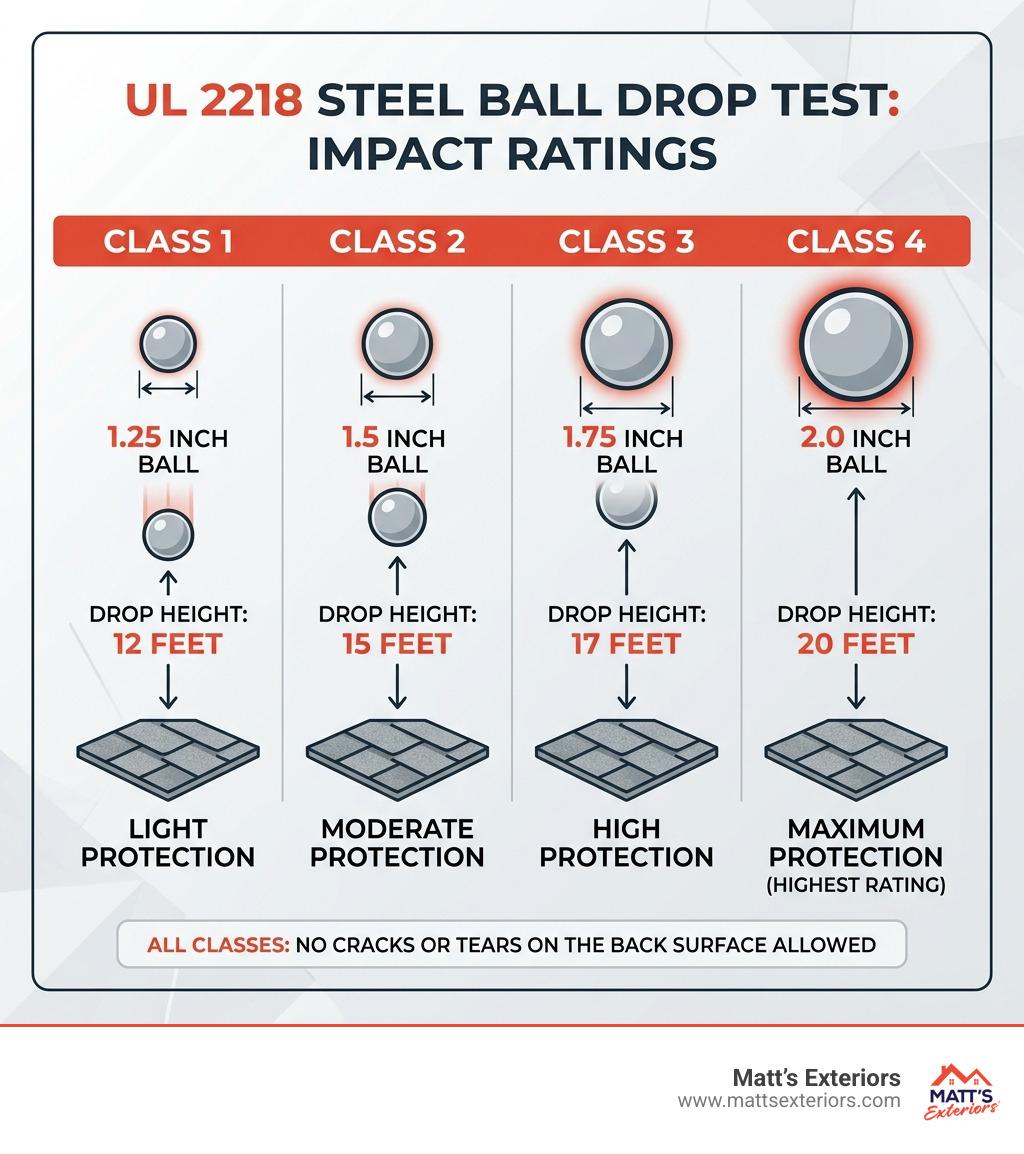
When we talk about "impact resistance," we aren't just using a marketing buzzword. There is a very specific, very rigorous scientific process involved. In the roofing world, the gold standard for this is the UL 2218 test. Developed in the mid-1990s following a series of devastating hailstorms, this test was designed to give homeowners a clear way to measure how much punishment a shingle can take.
The test isn't just about whether the shingle looks okay on the outside; it’s about structural integrity. According to the Class 4 Impact Resistant Shingles Explained guide, the test simulates the terminal velocity and kinetic energy of falling hail by dropping steel balls onto the shingle surface.
To earn a Class 4 rating, a shingle must withstand a 2-inch diameter steel ball dropped from a height of 20 feet. The ball is dropped twice in the same spot to ensure the material doesn't weaken or fail upon repeated impact.
But here is the kicker: the shingle is only considered to have "passed" if there is no evidence of fractures, cracks, or splits on the backside of the shingle. Why the backside? Because even if the front looks mostly fine, a crack on the back means the watertight seal is broken. Once that happens, moisture can seep into your roof deck, leading to rot, mold, and eventual leaks inside your home.
While the test allows for "cosmetic damage"—meaning you might see a small dent or some granule loss—the structural integrity must remain 100% intact. It’s like a high-quality car bumper; it might get a scratch, but it protects the engine and the passengers inside.
We often get asked by homeowners in Marietta or Alpharetta if they can just "settle" for Class 3 shingles. While Class 3 is certainly better than a standard shingle, the jump to Class 4 is significant. Think of it as the difference between a light jacket and a heavy-duty parka in a blizzard.
Feature Class 3 Shingles Class 4 Shingles Steel Ball Size 1.75 inches 2.0 inches Drop Height 17 feet 20 feet Impact Energy Simulates 60 mph hail Simulates 90 mph hail Durability High Maximum
The difference in ball size might seem small (only a quarter of an inch), but the kinetic energy generated by a 2-inch ball falling from 20 feet is much higher. In fact, that impact is strong enough to crack a 4-inch concrete paver in half. If you're considering a roof replacement, understanding these tiers helps you decide how much protection your specific neighborhood needs.
How does a piece of asphalt survive an impact that would shatter concrete? The secret lies in the chemistry. Most class 4 impact shingles are manufactured using SBS-modified asphalt. SBS stands for Styrene-Butadiene-Styrene, which is a fancy way of saying "rubberized asphalt."
By blending high-quality asphalt with these synthetic polymers, manufacturers create a shingle that acts like a shock absorber. Standard asphalt shingles are relatively rigid; when something hits them hard, they tend to crack or shatter, especially as they age and become brittle. SBS-modified shingles, however, have "rubberized" characteristics that allow them to bend and then bounce back. This flexibility is what keeps the granules stuck to the surface and prevents the shingle from tearing.
Recent innovations have even combined this toughness with environmental benefits. Some shingles feature Class 4 impact rating and advanced technology like smog-reducing granules, which use sunlight to turn smog into water-soluble ions—effectively giving your roof the air-cleaning power of several trees.
One of the biggest enemies of a roof in Georgia is "thermal shock." Our weather can go from a 90-degree afternoon to a 50-degree night in a heartbeat. This constant expansion and contraction makes standard shingles brittle over time.
Class 4 shingles, particularly those reinforced with a polymer mesh or a heavy-duty fiberglass mat, stay pliable even in extreme cold. Some products are rated to perform without cracking at temperatures as low as 0°F. This flexibility is vital for granule adhesion. When hail hits, you want the granules to stay put because they protect the underlying asphalt from UV rays. If you find yourself needing professional roof repair services after a storm, it’s often because standard shingles lost their granules, leaving the roof "naked" and vulnerable to the sun.
While the "Class 4" label specifically refers to impact, these shingles are usually the "overachievers" of the roofing world. Because they are built so tough, they often carry other high-performance ratings.
If you've recently dealt with a rough season, our storm damage restoration guide can help you navigate the next steps, but installing Class 4 shingles is the best way to ensure you don't need that guide again anytime soon.
We know what you’re thinking: "This sounds great, Matt, but what’s the catch?" Usually, the catch is the upfront price. Class 4 impact shingles do cost more than your run-of-the-mill architectural shingles. However, looking at the "sticker price" alone is a mistake. You have to look at the lifecycle cost.
When you install a standard roof, you are essentially gambling that a major hailstorm won't hit your house for the next 15 to 20 years. In Metro Atlanta, that's a risky bet. Between the potential for insurance discounts, reduced maintenance, and increased home value, the "premium" for Class 4 shingles often pays for itself faster than you’d think. For a deeper dive into how these costs break down, check out our article on new residential roofing price factors.
On average, Class 4 shingles cost about 10% to 25% more than regular shingles. For a typical home, this might mean an extra $1,000 to $2,500 on the total project cost.
Now, let's look at the return:
If you're currently dealing with a roof that's seen better days, even small asphalt shingle repair insights show that constant patching is more expensive in the long run than upgrading to a durable system.
This is where the math gets really interesting. Because Class 4 shingles significantly reduce the likelihood of a total roof replacement claim, many insurance companies are eager to reward homeowners who install them.
In many states, including Georgia, insurance carriers offer premium reductions ranging from 5% to 35%.
Geography is everything in roofing. If you lived in a desert, we’d talk about UV protection. If you lived in the Pacific Northwest, we’d talk about moss. But here in Metro Atlanta—from Peachtree City up to Cumming—we have to talk about the "Spring Squeeze." This is when warm Gulf air hits cold northern fronts right over our heads, resulting in high winds and frequent hail.
In 2022 alone, there were over 4,400 major hail events in the U.S. State Farm reported paying out over $3.5 billion in hail claims that year—a $1 billion increase from the year before. Our region is right in the crosshairs.
Hail damage is often invisible from the ground. It doesn't always look like a hole in the roof; sometimes it looks like a "bruise."
If your neighborhood was recently hit by a storm, look for dented cars, cracked siding, or shredded leaves on the ground. These are all indicators that your roof took a beating. If you're curious about the technical side of how your roof is built to handle these slopes, you might find our guide on the best roof pitch for shingles helpful.
A Class 4 shingle is only as good as the person nailing it down. These materials are heavier and require specific handling to ensure the warranty remains valid.
For a full breakdown of what a proper install looks like, see our comprehensive guide to roof installation.
Most manufacturers back these products with 50-year limited warranties. Because of the SBS-modified asphalt and superior granule adhesion, they tend to stay "young" much longer than standard shingles. While a standard roof might last 20 years in Georgia, a Class 4 roof can easily push past 30 or 40 years if properly maintained.
Yes, many major carriers in Georgia offer premium credits for UL 2218 Class 4 roofs. The discount varies by company—some offer a flat percentage, while others base it on the age of the roof and your location. It’s one of the few home improvements that can actually lower your monthly overhead.
No roof is 100% "hail-proof." If a 4-inch "gorilla" hailstone falls from the sky, it's going to cause damage regardless of the rating. However, class 4 impact shingles are designed to handle the 1-inch to 2-inch hail that makes up the vast majority of storms. They prevent the structural cracks that lead to leaks, even if they sustain minor cosmetic dents.
At the end of the day, your roof is the only thing standing between your family and the elements. In Metro Atlanta, those elements can be pretty unforgiving. Upgrading to class 4 impact shingles isn't just about getting a "fancy" roof; it’s about peace of mind. It’s about knowing that when the sky turns gray and the sirens go off, your home is wearing the best armor available.
At Matt’s Exteriors, we take pride in providing high-quality workmanship and using only the most trusted materials. We’ve been serving our neighbors in places like Peachtree City, Marietta, and Buford since 2007, and we’d love to help you protect your investment.
Ready to see if a Class 4 roof is right for you? Schedule a consultation for our services today, and let’s give your home the protection it deserves.