
Get Your Instant Quote Now!
Get Started
A commercial roof replacement is one of the largest capital investments a property owner will make. To get a quick estimate of your potential costs and options, use this fast-reference guide:
I am Matt Lopez, founder of Matt’s Exteriors. Since 2007, my team and I have helped property owners across Metro Atlanta navigate complex exterior renovations, applying our deep hands-on experience to guide clients through successful, stress-free commercial roof replacement projects. We build systems designed to withstand Georgia's intense heat and unpredictable storms while protecting your bottom line.
Let's look at how you can make the smartest decision for your property.
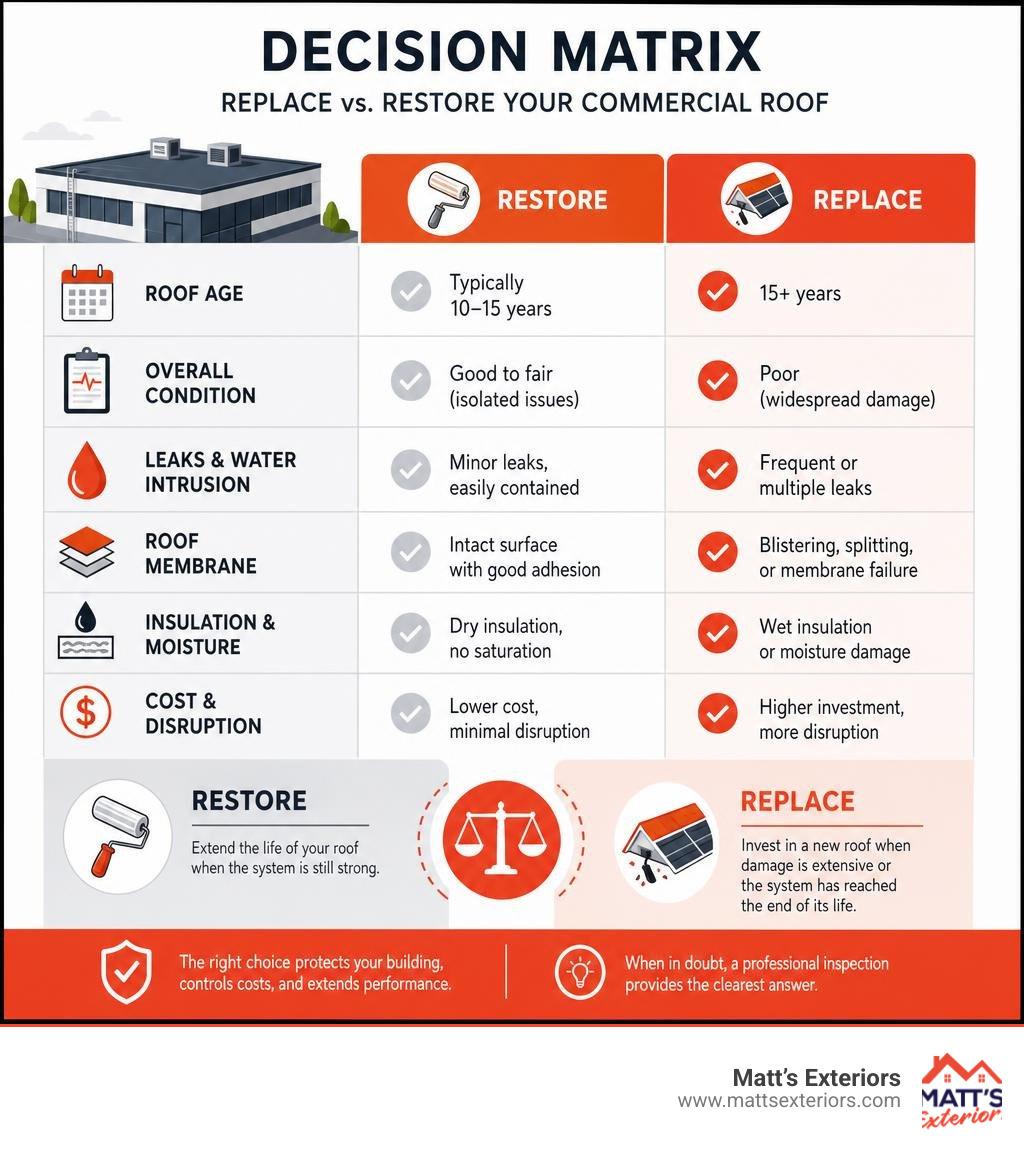
Determining whether to invest in a complete commercial roof replacement or opt for targeted repairs is a critical financial decision. While we always aim to extend the life of your existing system through professional Commercial Flat Roof Repair, there comes a point where patching is no longer cost-effective.
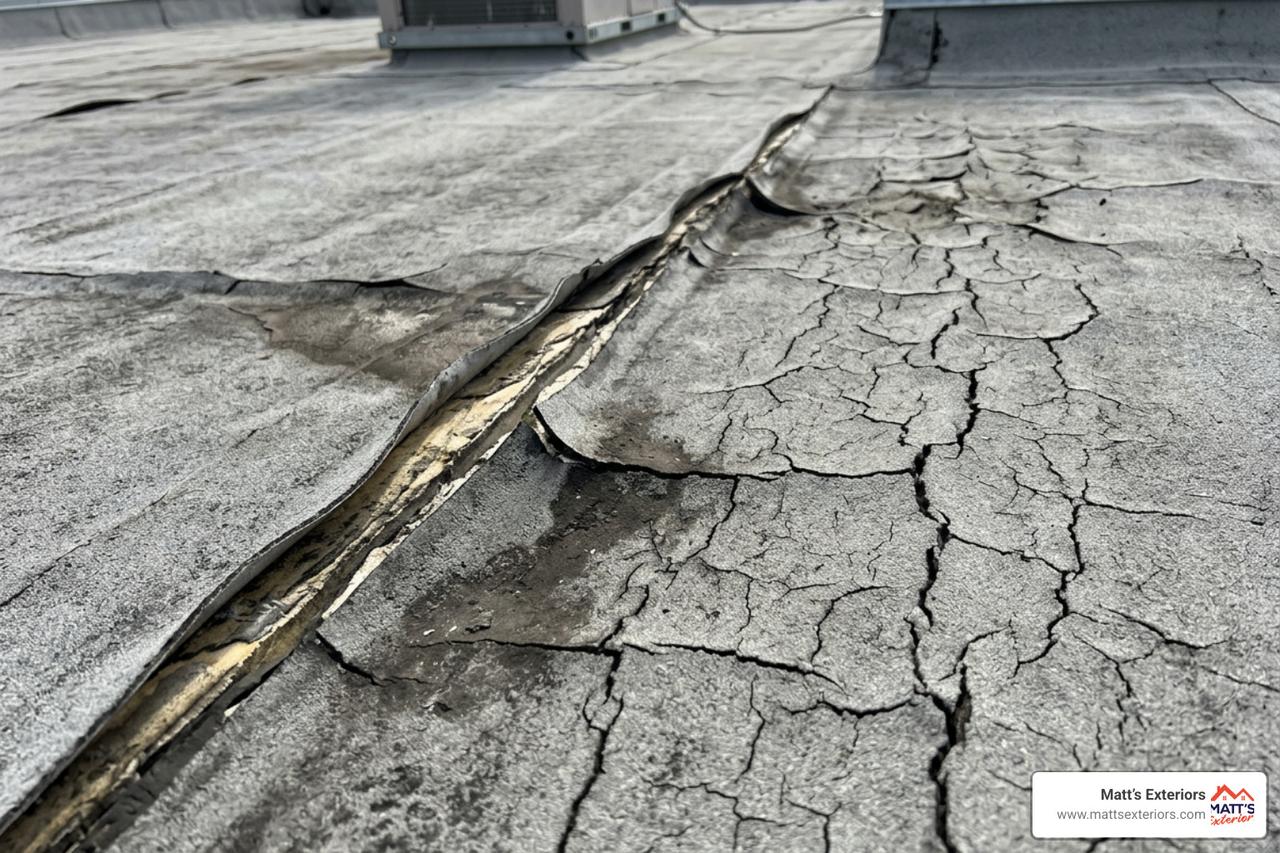
The primary physical indicators that your commercial roof has reached the end of its functional life include:
It is an industry fact that 85% of commercial roof replacements could be prevented or significantly delayed with timely intervention methods like professional roof restoration. A liquid-applied roof coating or elastomeric restoration system can seal minor imperfections and extend your roof's lifespan by 10 to 20 years at a fraction of the cost.
However, restoration is only a viable candidate if the underlying insulation is dry and the structure is sound. If moisture scans reveal that more than 20-25% of your roof's insulation is wet, a complete commercial roof replacement is the only reliable way to protect your building and its assets.
If your building requires a new roof, you generally have two paths: a re-roof (also known as an overlay or recover system) or a full tear-off replacement.
An overlay involves leaving the existing roof assembly in place, repairing minor defects, and installing a new membrane directly over the old one.
A full tear-off involves stripping the entire roof assembly down to the structural deck, replacing damaged decking, installing new high-R-value insulation, and laying down a brand-new membrane.
Before making this decision, we must consult local building codes. In Georgia, building codes strictly enforce a two-roof limit. If your building already has two layers of roofing installed, local codes legally mandate a complete tear-off to prevent structural overload.
To determine if an overlay is structurally safe and code-compliant, we perform non-destructive moisture scans (such as infrared thermography) and core sampling. These tools pinpoint exactly where moisture is trapped. If the deck is dry and you only have one existing roof layer, an overlay can be a highly cost-effective path. For a deeper understanding of complete system installations, see our A Comprehensive Guide to Roof Installation.
Selecting the right material is the foundation of a successful commercial roof replacement. Each material offers unique advantages in terms of upfront cost, longevity, and performance under Georgia's intense summer sun.
Roofing System Average Cost (per Sq. Ft.) Expected Lifespan Best Use Case Key Performance Factors TPO (Thermoplastic Polyolefin) $4.50 - $14.00 15 - 25 Years Retail, Warehouses, Offices Highly reflective, budget-friendly, heat-welded seams. EPDM (Rubber) $5.00 - $13.00 20 - 30 Years Large Industrial Buildings Extremely durable, handles thermal shock, black or white. PVC (Polyvinyl Chloride) $10.00 - $16.00 20 - 30 Years Restaurants, Food Processing Chemical, grease, and fire-resistant; highly durable. Modified Bitumen $9.00 - $15.00 15 - 20 Years High-Traffic Roofs Multi-layered, highly puncture-resistant, traditional. Metal (Standing Seam) $15.00 - $30.00+ 40 - 60 Years Sloped Commercial, Schools Exceptional longevity, low maintenance, fully recyclable.
Single-ply membranes are the most popular choices for modern commercial flat roofs. They are lightweight, cost-effective, and highly efficient. When exploring High-Quality Roofing Materials, single-ply options dominate the market:
Budgeting for a commercial roof replacement requires looking at several variables beyond simple square footage.
When we calculate a custom estimate for your property, we evaluate the following primary cost drivers:
Partnering with an experienced Local Commercial Roofer ensures that all of these variables are accounted for in an itemized, transparent proposal, eliminating unexpected change orders mid-project.
Executing a commercial roof replacement in Metro Atlanta requires strict compliance with local municipal codes and safety regulations.
Before a single piece of old membrane is removed, proper building permits must be secured from the local building department (whether that is the City of Atlanta, Fulton County, Gwinnett County, or Cobb County).
Commercial roofing is a high-risk environment. We maintain rigorous safety protocols, utilizing OSHA-compliant fall protection systems, warning lines, and safety monitors. Working with certified members of the Georgia Roofing Contractors Association guarantees that your project is handled by licensed, insured, and safety-conscious professionals.
When investing in a new roof, you have access to two distinct types of warranties:
For a standard warehouse or commercial office building, a professional crew can typically complete a re-roof or replacement in one to two weeks. However, the exact timeline depends heavily on the total square footage, the complexity of the roof's penetrations, and weather conditions. Rain, high winds, or extreme heat can temporarily pause work to ensure crew safety and protect the building's interior from exposure. We utilize phased installation plans to keep your building dry and secure throughout the entire process.
Yes, absolutely! If your roof's structural decking is strong and moisture scans show that the insulation is dry, a commercial roof restoration is an excellent alternative. Restorations utilizing high-solids silicone or acrylic coatings typically cost 50% to 75% less than a full tear-off and replacement.
Restoration coats the existing membrane to create a seamless, monolithic barrier against leaks, and the process can often be repeated at the end of the warranty period. If you are experiencing minor, localized issues, we recommend scheduling an inspection to see if our Roof Repair Services or a fluid-applied coating system can save you from a full replacement.
Upgrading to a reflective "cool roof" (like white TPO or PVC) and increasing your insulation's R-value will increase your upfront material costs. However, this investment delivers a massive return. Modern commercial roofing systems can reduce your building's heating and cooling costs by 15% to 30% compared to older, dark, or poorly insulated roofs.
Over the course of its 20-to-30-year lifespan, an energy-efficient roof easily pays for itself. Additionally, many energy-efficient upgrades qualify for federal tax deductions (such as Section 179D) or local utility rebates, helping to offset the initial capital expenditure.
A commercial roof replacement is more than just a maintenance expense—it is a strategic capital investment that protects your building’s structural integrity, enhances energy efficiency, and secures your business operations for decades to come. Attempting to cut corners with cheap materials or uncertified labor will only lead to premature system failure and endless repair bills.
At Matt’s Exteriors, we bring over 12,000 completed projects of experience to every commercial job site across Metro Atlanta, from Alpharetta and Marietta down to Peachtree City and McDonough. We combine high-quality workmanship, trusted materials, and exceptional customer care to deliver roofing systems that stand the test of time.
Ready to protect your commercial asset with a high-performance roof? Schedule a consultation for our professional services today, and let our team of experts design a custom solution tailored to your building and budget.