
Get Your Instant Quote Now!
Get Started
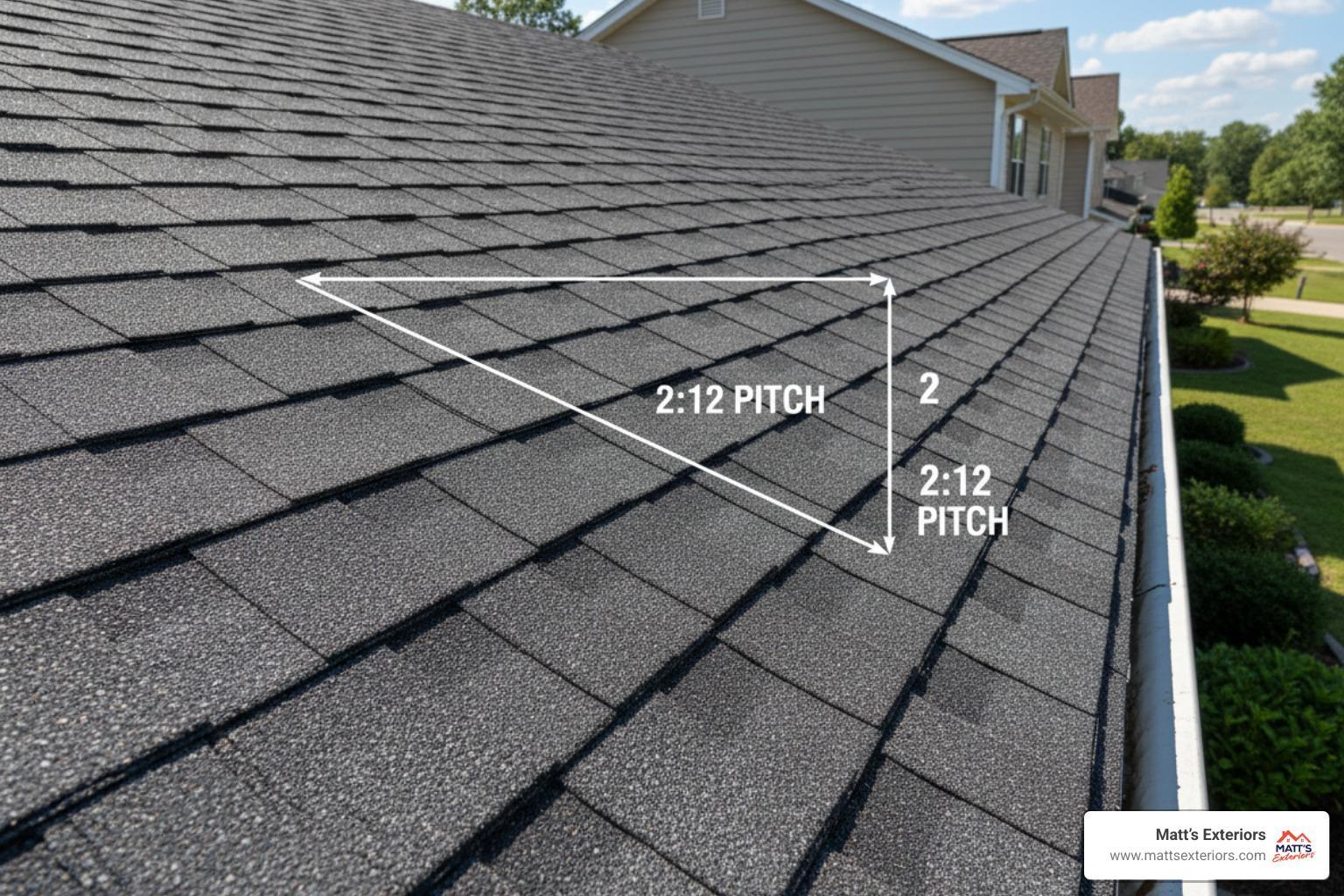
The minimum slope for composition shingles is 2:12 — meaning the roof must rise at least 2 inches for every 12 inches of horizontal run. This is required by the International Residential Code (IRC) Section R905.2.2 and is backed by every major shingle manufacturer.
Here's a quick-reference summary:
Slope Classification Asphalt Shingles Allowed? Below 2:12 Flat roof No — use membrane systems 2:12 to 4:12 Low slope Yes — with special underlayment 4:12 to 9:12 Standard slope Yes — standard installation Above 9:12 Steep slope Yes — up to 21:12 max
Here's why this matters: shingles are water-shedding, not waterproof. They rely on gravity to move water off the roof quickly. When a slope is too shallow, water moves slowly — or not at all. That creates leaks, shingle damage, and voided warranties.
Most Metro Atlanta homes have roofs in the 4:12 to 9:12 range, which is ideal. But porches, additions, and low-profile architectural designs can push slopes dangerously close to — or below — the minimum.
Getting this wrong is expensive. Installing shingles on an insufficient slope leads to premature failure, failed inspections, and denied warranty claims.
I'm Matt Lopez, owner of Matt's Exteriors, and with nearly two decades of roofing experience across Metro Atlanta, I've seen what happens when the minimum slope for composition shingles is ignored — from persistent leaks to full roof replacements that could have been avoided with the right materials from the start.
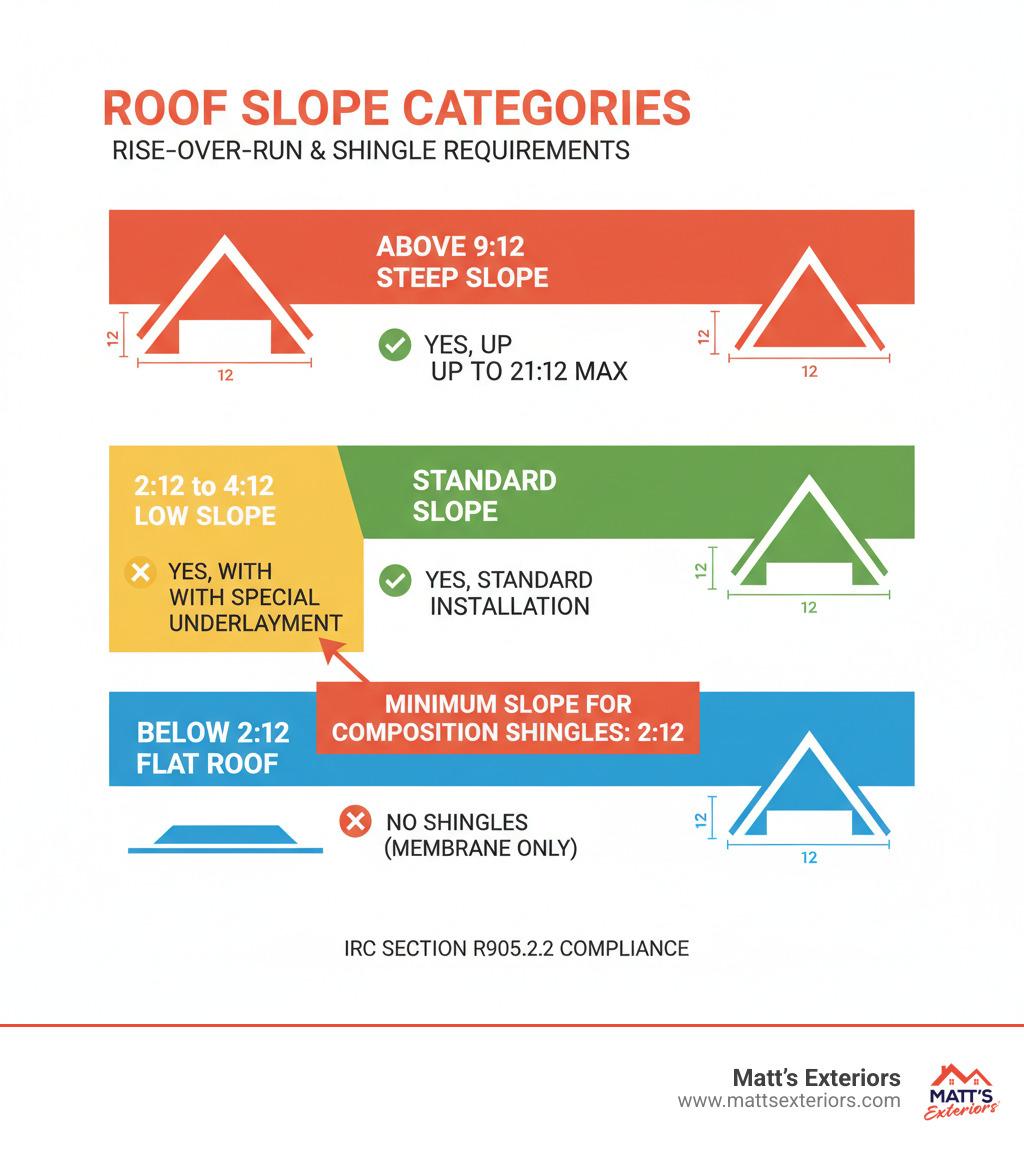
When we talk about the health of your home in places like Marietta or Alpharetta, the roof is your first line of defense. But not all roofs are created equal. Understanding the "pitch" or "slope" of your roof is about more than just aesthetics; it is a fundamental engineering requirement.
In the roofing world, we use the terms "slope" and "pitch" to describe how steep your roof is. While some technical circles differentiate between them, the industry standard—and the language used in building codes—focuses on the slope. This is expressed as a rise-over-run ratio.
Imagine you are standing on your roof. For every 12 inches you move horizontally (the "run"), how many inches does the roof surface go up (the "rise")? If it goes up 4 inches, you have a 4:12 slope. If it only goes up 2 inches, you are at the absolute minimum slope for composition shingles.
This is a distinction we frequently explain to our customers in Cumming and Roswell. Asphalt composition shingles are designed to be water-shedding. This means they work with gravity to encourage water to flow downward and off the edge of the roof. They are not a solid, "waterproof" bathtub-style seal.
If the roof is too flat, water doesn't shed; it lingers. It can even move backward under the shingles through a process called capillary action. This is why the minimum slope for composition shingles is so strictly enforced by both the International Residential Code (IRC) and manufacturers.
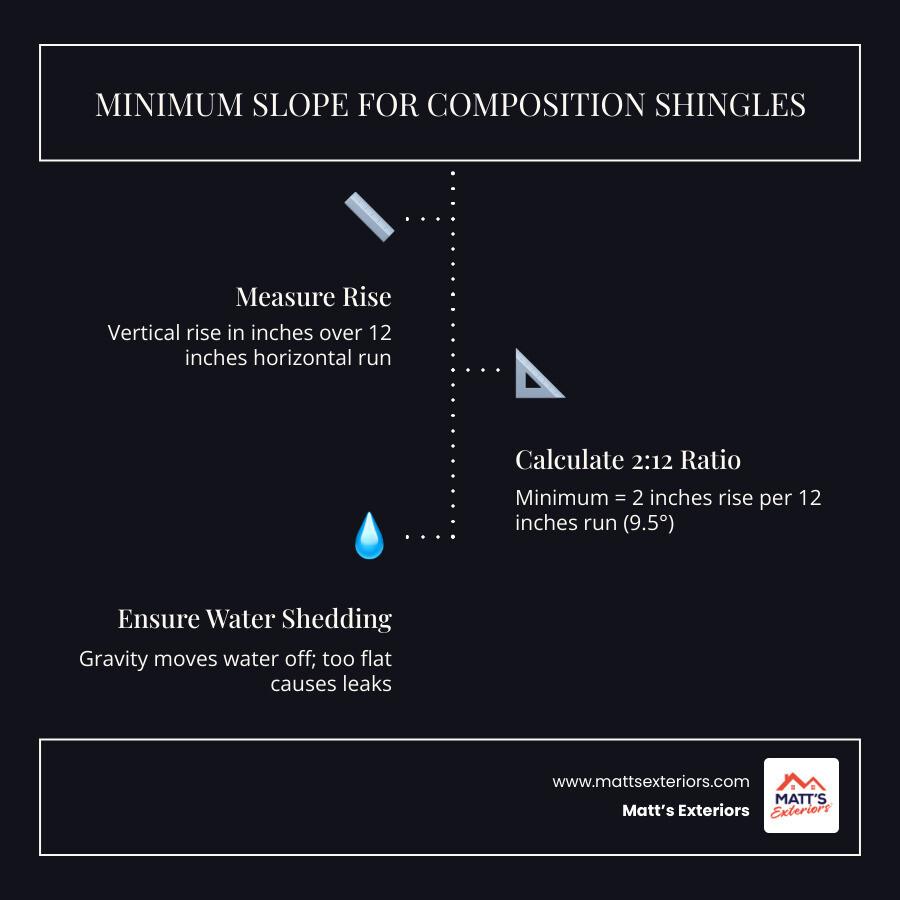
According to IRC Section R905.2.2, the absolute minimum slope for composition shingles is a 2:12 ratio. In geometry terms, this equates to approximately 9.5 degrees.
Whether we are working on a project in Fayetteville or Kennesaw, we must adhere to these standards to ensure the home passes inspection. Residential Roof Slopes | Minimum Slope Standards Explained notes that these requirements exist specifically to manage water drainage performance.
If we attempt to install shingles on a slope shallower than 2:12, we aren't just breaking "best practices"—we are violating the law and putting your home at risk. For a deep dive into these rules, you can read The Minimum Slope For Asphalt Shingles Explained.
The Asphalt Roofing Manufacturers Association (ARMA) and major brands like GAF, CertainTeed, and Owens Corning all align on this 2:12 rule. Why? Because their warranties depend on the product being used as intended. If shingles fail because they were installed on a 1:12 slope, the manufacturer will deny the claim, citing improper installation. Gravity is the engine that makes shingles work; without enough of it, the system fails.
Just because you can install shingles on a 2:12 slope doesn't mean you can install them the same way you would on a steep 8:12 roof. Any roof between 2:12 and 4:12 is considered a "low-slope" application.
On a standard slope (4:12 and up), a single layer of underlayment is usually sufficient. However, on a low-slope roof, water runs off much more slowly. To combat this, we must use double underlayment. This typically involves applying 19-inch wide strips of underlayment, with each subsequent course overlapping the previous one by 19 inches. This creates a double layer of protection across the entire roof deck.
As noted in Minimum Slope for an Asphalt Shingle Roof - IKO, this extra layer is vital for preventing leaks caused by wind-driven rain or ice dams. If you are curious about what else works on these pitches, check out Best Roofing Material For 212 Pitch.
On a low-pitched roof, water can actually "wick" or climb upward between the shingles. This is capillary action. On a steep roof, gravity wins. On a 2:12 roof, the water might stay long enough to find its way under the shingle lap. This is why the extra sealant and underlayment are non-negotiable for us when working in rainy Metro Atlanta climates like Peachtree City or Woodstock.
While felt paper was the old standard, modern roofing often utilizes self-adhering membranes (often called "Ice and Water Shield"). These membranes meet ASTM D1970 standards and provide a truly watertight seal against the roof deck.
Minimum Slope for Shingles: What Contractors Need to Know emphasizes that for low-slope roofs, these leak barriers are essential, especially at the eaves. In Georgia, where we don't get as much ice as the North, we still deal with heavy summer downpours that can "back up" under shingles. We recommend extending this protection at least 24 inches inside the exterior wall line to ensure total security.
There is a common debate: which shingle is better for a low slope?
Both are allowed as long as the Best Roof Pitch For Shingles guidelines are followed. The key isn't the shingle type as much as the installation method beneath it.
How do you know if your roof meets the minimum slope for composition shingles? You can do a quick check yourself before calling us out to Marietta or Dunwoody.
In 2026, we have high-tech options too. Apps like GAF QuickMeasure or simple "Pitch Gauge" apps use your phone's camera and gyroscope to calculate the slope instantly.
Rise:Run Degrees Suitability 1:12 4.8° No Shingles (Membrane only) 2:12 9.5° Minimum for Shingles (Double Underlayment) 3:12 14.0° Low Slope (Double Underlayment) 4:12 18.4° Standard Slope (Standard Install) 6:12 26.6° Standard Slope (Ideal Drainage)
If a roof is installed below the minimum slope for composition shingles, or if the low-slope requirements are ignored, the results are predictable:
For more on these risks, Minimum Roof Slope For Shingles: Essential Guidelines For Compliance And Durability provides an excellent breakdown of long-term durability issues.
On the other end of the spectrum, we have steep roofs. While most of our work in Sandy Springs or Johns Creek falls in the "normal" range, some historic homes or modern designs feature very steep pitches.
Did you know there is a "maximum" for standard installation? ARMA considers 21:12 (a very steep 60-degree angle) the limit for "normal" application. Beyond this, gravity actually works too well—it can pull the shingles down before the sealant has a chance to bond. On these steep "mansard" style roofs, we use hand-sealing techniques, applying extra spots of roofing cement under each shingle to ensure they stay put.
If your roof pitch is below 2:12 (like a flat porch roof or a commercial building in Atlanta), shingles are off the table. Instead, we look at membrane systems:
You can compare these options in our guide: Rolled Roofing Vs Shingles Whats Best For A Low Slope Roof.
No. This is a major code violation. A 1:12 pitch does not provide enough gravity-assisted drainage for shingles to work. Water will inevitably back up under the laps, causing the roof deck to rot. If you have a 1:12 pitch, you must use a membrane system like TPO or modified bitumen. Installing shingles here will also void your manufacturer warranty immediately.
Manufacturer warranties are contracts. They specify that the product must be installed according to their instructions and local building codes. If you install shingles on a slope below 2:12, or fail to use double underlayment on a 2:12 to 4:12 slope, the warranty is effectively void. If the shingles leak or blow off, the manufacturer will point to the improper slope as the cause, leaving the homeowner (or the contractor) liable for the repairs.
We still love the classic tape measure and 12-inch level for accuracy on-site. However, digital pitch gauges are now standard for many pros. For homeowners, smartphone apps are quite accurate. If you want a professional-grade remote measurement, tools like GAF QuickMeasure use satellite and aerial imagery to calculate your roof's slope without anyone even stepping onto a ladder.
Understanding the minimum slope for composition shingles is the difference between a roof that lasts 25 years and one that fails in five. Whether you are in McDonough, Suwanee, or right in the heart of Atlanta, your roof's geometry dictates what materials will keep your family dry.
At Matt’s Exteriors, we take these codes seriously. We don't cut corners on low-slope underlayment, and we won't recommend shingles for a roof that clearly needs a membrane system. With over 12,000 projects completed since 2007, we have the local expertise to ensure your roof is not only beautiful but technically sound and fully warrantied.
If you are worried about a low-pitched section of your roof or are planning an addition in Metro Atlanta, don't guess—get a professional assessment.