
Get Your Instant Quote Now!
Get Started
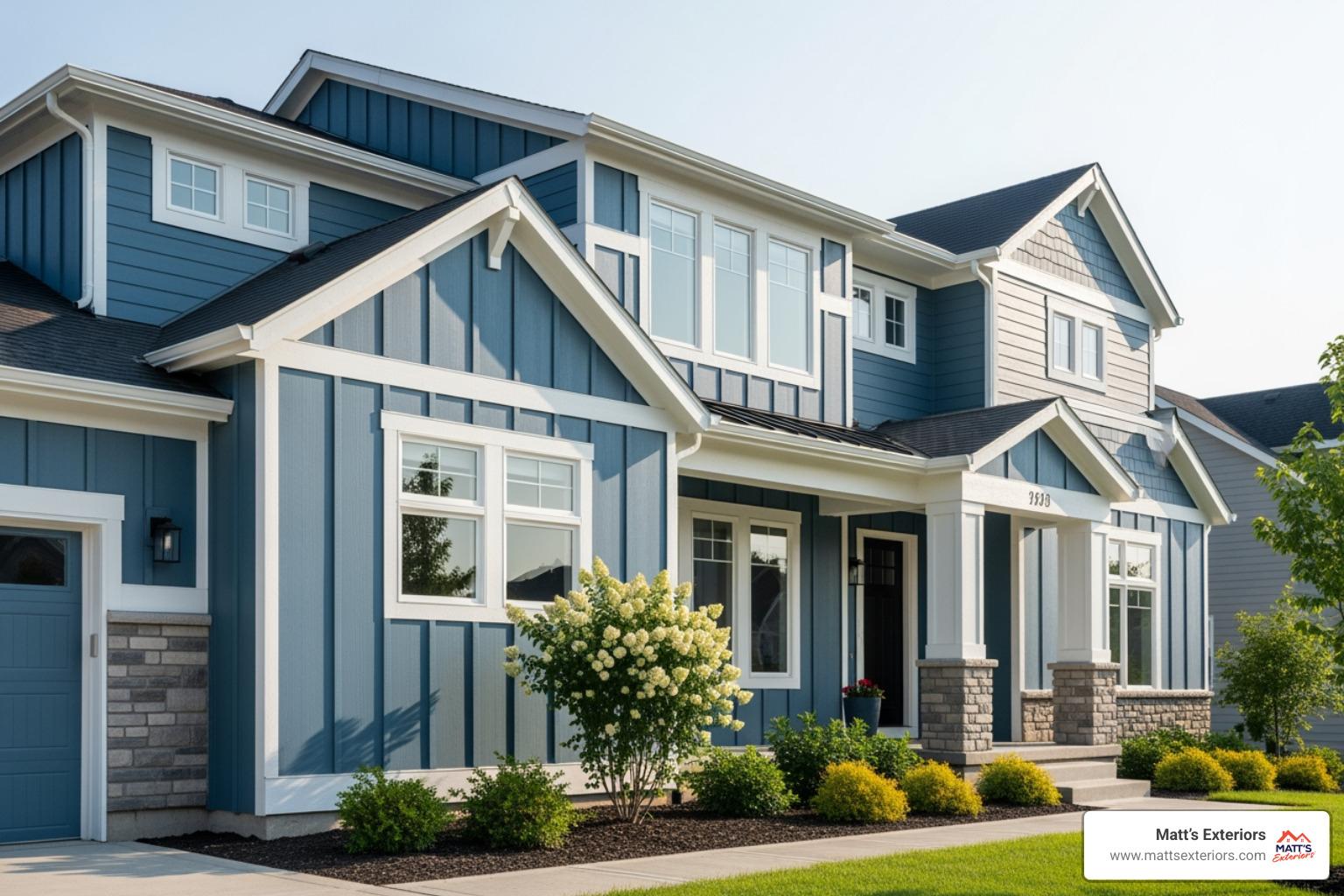
Choosing the right exterior paint sheen is one of the most important — and most overlooked — decisions in any home painting project. Most homeowners spend hours picking the perfect color, then grab whatever finish is on the shelf. That's a mistake that can cost you years of durability and hundreds of dollars in early repaints.
Quick Answer: Which exterior paint sheen should you use?
Surface Recommended Sheen Why Siding (most homes) Satin Best balance of durability, washability, and appearance Brick & masonry Flat / Matte Preserves texture; allows the surface to breathe Trim & fascia Semi-gloss Crisp contrast; easy to clean; resists moisture Front doors Semi-gloss or Gloss Durable; stands up to daily contact; bold look Shutters Semi-gloss Higher sheen than siding creates visual separation Garage doors Satin or Semi-gloss Durable without excessive glare
Here's the short version: satin for the body, semi-gloss for the trim. That pairing covers roughly 70% of US residential repaints, according to a 2025 Painting Contractors Association member survey — and it's been the standard for about 60 years.
But the right answer for your home depends on your surface material, climate, color choice, and how much maintenance you want to deal with. That's exactly what this guide covers.
Sheen isn't just about looks. It directly affects how long your paint lasts, how well it resists Georgia's humidity and heat, and how easy it is to clean pollen, dirt, and mildew off your walls. Pick the wrong one, and even a premium paint job can look tired in just a few years.
I'm Matt Lopez, founder of Matt's Exteriors, and over nearly two decades of exterior remodeling across Metro Atlanta, I've seen how the wrong exterior paint sheen choice — often made in five seconds at the hardware store — leads to premature peeling, chalking, and costly repaints. This guide will help you get it right the first time.
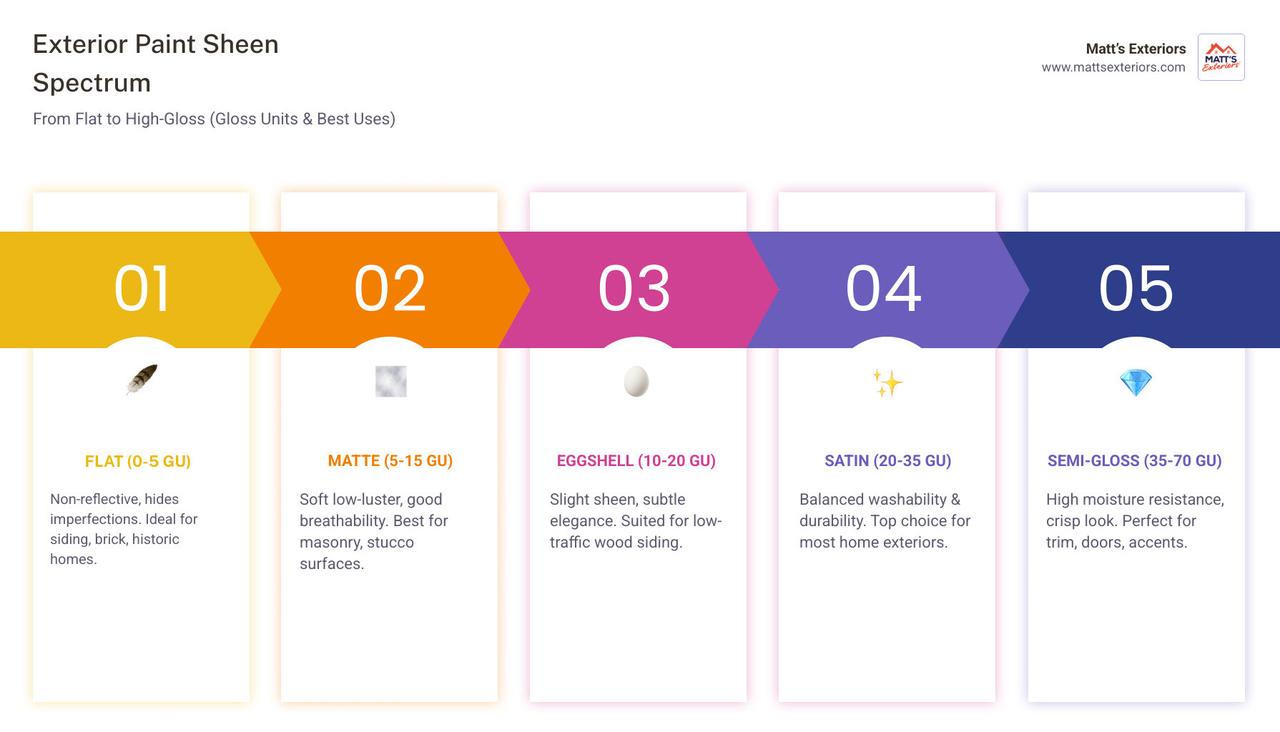
To understand exterior paint sheen, we have to look past the color and into the chemistry of the can. Paint is essentially a mixture of pigments (color), binders (resins), and solvents (liquids). The "sheen" refers to the level of light reflectivity of the dried paint film.
Technically, sheen is a built-in characteristic of the paint base itself. It isn't an additive or a topcoat you slap on afterward. When you go to a store in Alpharetta or Marietta, the technician is mixing your chosen color into a specific "Satin" or "Flat" base.
The ratio of resins to pigments is the secret sauce. Higher-sheen paints contain more resins and binders and fewer pigments. This creates a smoother, harder, and more non-porous surface once cured. For a deeper dive into these technicalities, check out An Expert Guide To Exterior Paint Sheen.
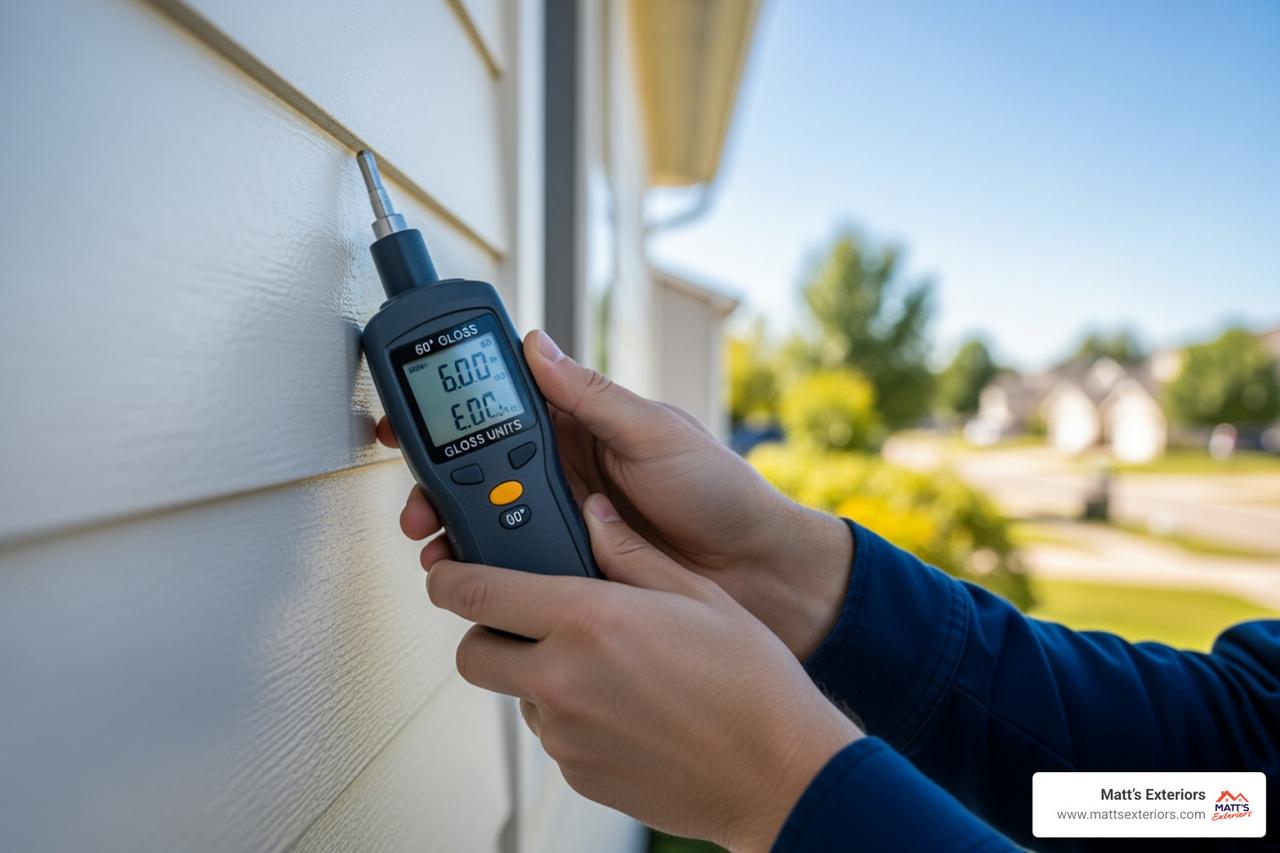
In the professional world, we don't just guess how "shiny" a paint is. We use a 60-degree gloss meter to measure "specular gloss." This measurement is expressed in Gloss Units (GU), following the ASTM D523 standards.
As explained in this 2026 Guide to Exterior Paint Finishes, understanding these units helps you move past marketing terms like "velvet" or "pearl" which can vary between brands.
Selecting a sheen is a functional strategy, not just an aesthetic one. Higher sheen levels generally offer better moisture resistance and film hardness. Because the surface is less porous, dirt, dust, and Georgia's infamous yellow pollen have a harder time "grabbing" onto the wall.
However, there is a trade-off. The shinier the paint, the more it highlights every bump, nail pop, and lap mark on your siding. Conversely, lower sheens are much more "forgiving" of surface imperfections but may require more frequent washing in humid climates to prevent dirt embedding. For more on this balance, see our article on the Best Paint Sheen For Exterior surfaces.
Choosing the right finish involves balancing the "hide" (how well it masks flaws) against "durability" (how well it stands up to the elements).
Sheen Type Gloss Units (GU) Best For Pros Cons Flat 0–5 Siding, Fences, Masonry Hides flaws; easy touch-ups Hard to clean; can become "chalky" Eggshell 10–25 Siding Low glare; better washability than flat Shows some flaws; harder to touch up Satin 25–35 Siding, Garage Doors The "Universal" choice; very durable Requires careful application Semi-Gloss 35–70 Trim, Doors, Shutters Moisture resistant; easy to wipe Highlights every imperfection High-Gloss 70+ Front Doors, Accents Dramatic "jewel" look; toughest film Very difficult to apply; shows all flaws
Source data adapted from 3 Best Paint Sheens for Home Exteriors.
Flat paint is the ultimate "hider." Because it absorbs light rather than reflecting it, it is excellent for older homes in places like Roswell or Senoia where the wood siding might be weathered or uneven. It provides a rich, velvety look that many find sophisticated.
However, flat paint acts a bit like a chalkboard. If you try to scrub it, you might end up "burnishing" it—creating a shiny spot where you rubbed. It’s best for low-traffic areas or historic homes where a modern shine would look out of place. Learn more in A Guide To The Most Common Exterior Paint Finishes Used By Pros.
In 2026, Satin (sometimes called Low-Lustre by brands like Benjamin Moore) remains the king of siding. It is the default for roughly 70% of American homes for a reason. It offers enough "slip" to allow rain to wash away dust, yet it isn't so shiny that your house looks like it's wrapped in plastic.
Satin is particularly effective on modern fiber cement siding (like James Hardie) or well-maintained wood. It provides a subtle glow that makes colors look richer and more vibrant than they do in a flat finish. For more siding-specific tips, visit Best Sheen For Siding.
Your trim, fascia, and soffits are the "frame" of your house. To make that frame pop, we almost always recommend a Semi-Gloss finish. The contrast between a satin body and semi-gloss trim creates an "architectural shadow play" that adds depth to your home's appearance.
Semi-gloss is also a practical choice for window sills and door frames because these areas are prone to collecting water and being touched. A higher sheen provides a harder barrier against rot and wear. For shutters and front doors, you can even venture into High-Gloss for a "jewel-like" focal point. Check out our guide on What Paint Finish For Exterior Trim for more details.
Living in the Metro Atlanta area—from Kennesaw down to Peachtree City—presents unique challenges for exterior paint sheen. We deal with intense UV rays, high humidity, and a pollen season that covers everything in neon yellow.
The material of your home dictates the sheen as much as the style does.
As noted by The Ultimate Guide to Satin vs. Semi-Gloss, matching the sheen to the substrate is the key to a job that lasts 15 years instead of five.
Modern paint technology in 2026 has come a long way. Premium lines like Sherwin-Williams Emerald or Duration are designed to resist "chalking"—that white powdery substance that forms as paint breaks down under UV light.
Higher sheens generally resist fading better because they reflect more of the sun's energy. However, in our humid climate, mildew resistance is just as important. Glossier finishes are less hospitable to mold and algae growth because they don't hold onto moisture as long as flat finishes do. To see which products we recommend for local homes, see Sherwin Williams Exterior Paint Products 101.
Applying high-sheen paint is significantly harder than applying flat paint. If you’re a DIYer in Woodstock or Cumming, be warned: glossier paints are prone to "lap marks." This happens when you paint over a section that has already started to dry, creating a double layer that looks shinier than the rest.
To get a professional result, we follow three golden rules:
Don't rely on a tiny paper swatch. Light looks different on a house in Dunwoody than it does in a showroom. We recommend buying 8 oz. sample jars or using peel-and-stick samples.
Apply them to the north and south sides of your house. Look at them at 8:00 AM, noon, and 6:00 PM. A satin that looks perfect in the morning might have an overwhelming glare in the direct afternoon sun.
For dark colors (like charcoal, navy, or forest green), we recommend a Matte or soft Satin (20–28 GU). Dark colors naturally absorb more heat. If you use a high-gloss finish on a dark color, the "mirror effect" can make the house look like it’s made of plastic. A lower sheen keeps the color looking sophisticated and hides the surface imperfections that dark colors tend to highlight.
Usually, yes. A gallon of semi-gloss is typically $3 to $6 more than a gallon of flat paint in the same product line. This is because it contains more expensive resins and binders. However, when you consider that semi-gloss can last 2–4 years longer on high-wear surfaces, the "lifetime value" makes it the cheaper option in the long run.
You can, but it usually looks like a mistake. Using a single sheen across the entire house (the "monochromatic" look) often makes a home look flat and "amateur." It removes the visual depth that helps your home's architectural features stand out. Stick to the professional standard: a lower sheen for the body and a higher sheen for the accents.
Choosing the right exterior paint sheen is a science that balances aesthetics, chemistry, and local climate. Whether you are in Alpharetta, Marietta, or anywhere in the Metro Atlanta area, the goal is a finish that protects your investment while making your neighbors a little bit jealous.
At Matt’s Exteriors, we’ve completed over 12,000 projects since 2007. We are a family-owned company that treats every home like our own, ensuring that the materials and sheens we select are perfectly suited for the Georgia sun.
Ready to give your home the protection and beauty it deserves? Schedule your 2026 exterior paint consultation with us today and let our experts help you find the perfect finish.