
Get Your Instant Quote Now!
Get Started

The minimum pitch for roll roofing is 1:12 — meaning the roof must rise at least 1 inch for every 12 inches of horizontal run. However, most manufacturers and roofing professionals recommend a 2:12 pitch for better long-term performance.
Here's a quick-reference summary:
Installation Method Minimum Pitch Roll roofing (concealed nail method) 1:12 Roll roofing (exposed nail method) 2:12 Standard asphalt shingles 2:12 (with special underlayment) Standard asphalt shingles (normal install) 4:12 Modified bitumen / EPDM / TPO 1/4:12
Your roof's pitch controls one thing above everything else: how fast water gets off the surface. On a steep roof, gravity does most of the work. On a low-slope roof, water lingers — and lingering water is the enemy of almost every roofing material.
That's where most homeowners run into trouble. They assume that if shingles work on the main house, they'll work on a flat porch addition or shed roof too. They don't. Shingles are a water-shedding system. They rely on gravity. Below a certain slope, water backs up under them and leaks follow.
Roll roofing — also called MSR or mineral-surfaced roll roofing — is specifically designed for these lower slopes. But even roll roofing has limits. Install it on a roof that's too flat, and you'll face ponding water, failed seams, and a voided warranty within just a few years.
I'm Matt Lopez, founder of Matt's Exteriors, and with nearly two decades of roofing experience across Metro Atlanta, I've seen what happens when the wrong material gets installed at the wrong minimum pitch for roll roofing — and this guide will help you avoid those costly mistakes.
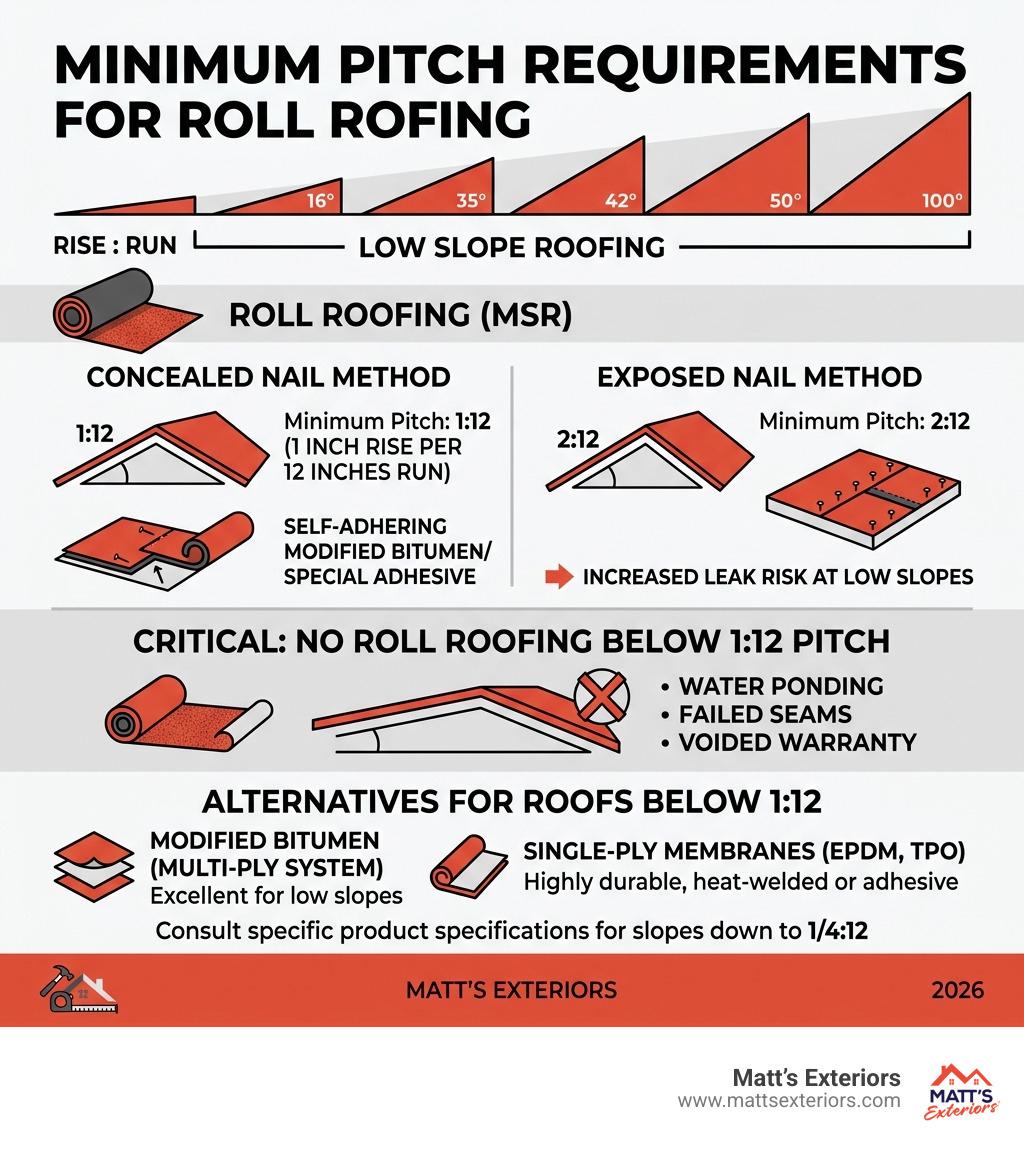
When we talk about roof pitch, we are describing the angle of the roof. In the United States, we measure this using "rise and run." If a roof rises 1 inch vertically for every 12 inches it runs horizontally, it has a 1:12 pitch. This is a very shallow angle, common on porches, carports, and home additions.
The absolute minimum pitch for roll roofing (specifically Mineral-Surfaced Roll roofing, or MSR) is established by both the International Building Code (IBC) and the International Residential Code (IRC). According to these standards, you should never install asphalt roll roofing on a slope less than 1:12.
However, the "code minimum" and the "manufacturer recommendation" aren't always the same. While the law might allow 1:12, many manufacturers prefer a 2:12 slope to ensure water doesn't pool. If you go below these thresholds, you are essentially asking for a leak. For more details on how these rules apply to different materials, you can check the Minimum Roof Pitch Allowed for Every Roofing Material.
To help you visualize where roll roofing fits in, we've put together this comparison:
Material Type Absolute Minimum Pitch Recommended Pitch Asphalt Shingles 2:12 (with double underlayment) 4:12 and up Roll Roofing (MSR) 1:12 2:12 Modified Bitumen 1/4:12 1/2:12 EPDM (Rubber) 1/8:12 1/4:12 TPO 1/4:12 1/4:12
As you can see, roll roofing is the middle ground. It handles slopes that would destroy a shingle roof, but it isn't quite robust enough for a dead-flat surface.
One of the most interesting things about the minimum pitch for roll roofing is that the requirement actually changes based on how you nail the material down. There are two primary ways to install MSR, and the choice you make determines how flat your roof can safely be.
This is the gold standard for low-slope applications. In this method, the nails are driven into the under-lap of the roofing material and then covered by the next overlapping sheet, which is sealed down with lap cement. Because the nail heads are never exposed to the weather, this method allows for a minimum pitch for roll roofing of 1:12. This is the preferred method for any residential structure where you want maximum service life.
In this method, nails are driven through the top layer of the material and left visible (though often dabbed with roofing cement). Because every nail is a potential leak point if water lingers, the slope requirement is steeper. You should only use the exposed nail method on roofs with at least a 2:12 pitch. For many homeowners looking at Asphalt Roll Roofing Menards or similar products, this is the DIY-friendly route, but it requires that steeper angle to stay safe.
Regardless of the method, roll roofing usually comes in 36-inch wide rolls. Success depends on the quality of the lap cement and the precision of the overlaps. If you're interested in the technical nuances, the Minimum Pitch Requirements for Rolled Roofing Installation – Collingwood Roof Repair provides a deep dive into these specifications.
What happens if you ignore these numbers and install roll roofing on a 1/2:12 or a flat roof? In Metro Atlanta, where we get heavy seasonal rains, the results are predictable and expensive.
For those considering pushing the limits with shingles instead, our Lowest Roof Pitch for Shingles Guide explains why that is often an even riskier gamble.
Not all "rolls" are created equal. Depending on your specific slope and budget, you might choose one of the following:
We often get asked, "Why can't I just put shingles on my 1:12 porch?" The answer comes down to how shingles are built.
Shingles are "gravity-dependent." They are individual pieces designed to let water slide from one to the next. On a steep roof, the water moves so fast it never has a chance to go "up" under the shingle. But on a low slope, water moves slowly. Capillary action can actually pull water upward under the bottom edge of a shingle.
Furthermore, in Georgia, we occasionally deal with ice dams or heavy debris buildup. On a low-slope shingle roof, these obstacles act like tiny dams, backing water up until it finds a nail hole. Roll roofing succeeds here because it has far fewer seams — a single 36-foot run of roll roofing replaces dozens of individual shingles, significantly reducing the "entry points" for water.
If you're debating between the two, our guide on Rolled Roofing vs Shingles: What's Best for a Low Slope Roof? breaks down the pros and cons in detail. You can also learn more about The Minimum Slope for Asphalt Shingles Explained to see why 4:12 is the "magic number" for most shingle manufacturers.
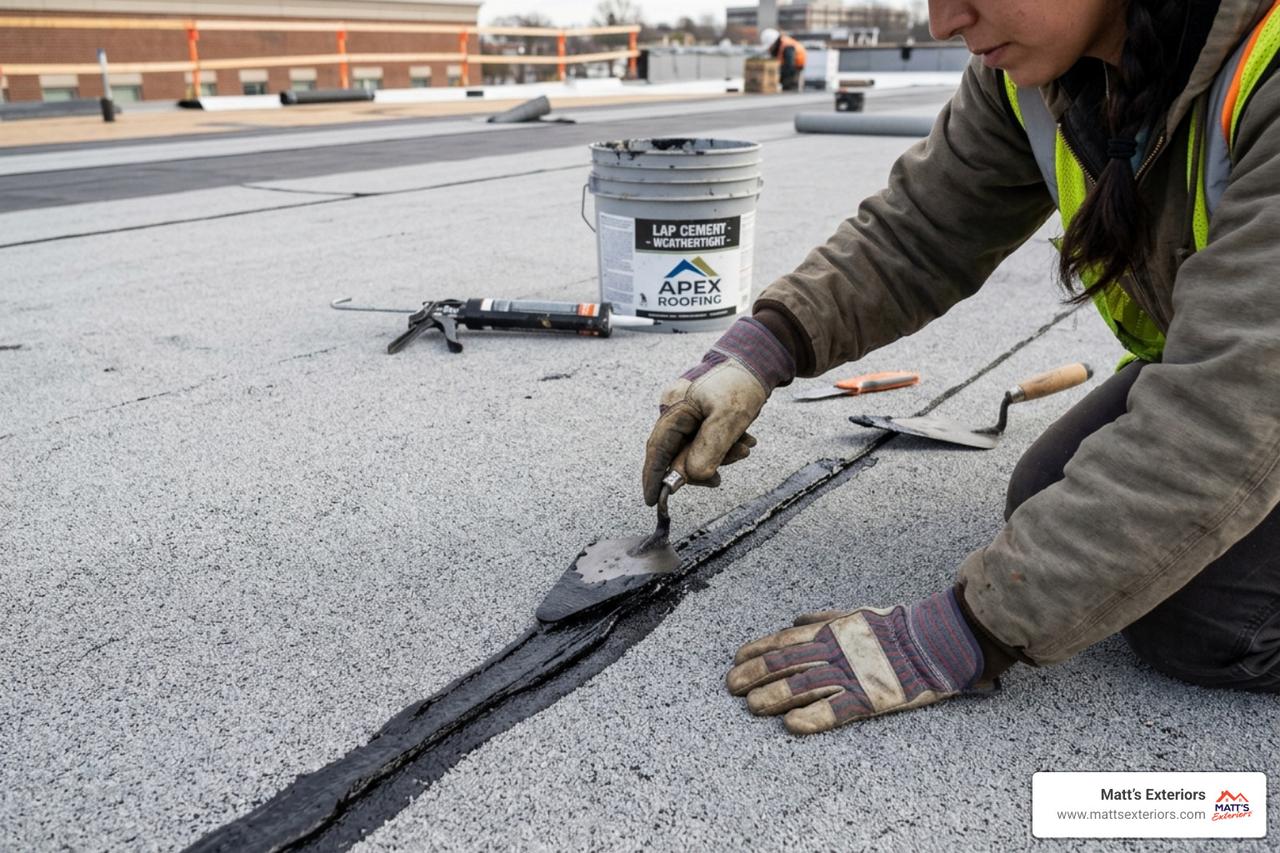
If you have determined that your roof meets the minimum pitch for roll roofing, you need to follow a strict protocol to ensure it lasts. At Matt's Exteriors, we've refined this process over thousands of projects in the Atlanta area.
Never install roll roofing if the temperature is below 45°F. Asphalt becomes brittle in the cold. If you try to unroll it on a chilly morning in Marietta or Woodstock, the material can develop "micro-cracks" that you won't even see until the roof leaks a year later. If you must install in cooler weather, keep the rolls in a heated garage until the moment you are ready to lay them down.
Even though some codes allow roll roofing to be nailed directly to the deck, we always recommend a high-quality underlayment. For very low slopes, a "peel and stick" ice and water shield is the best defense. You can read more about Peel and Stick Roofing for Flat Roofs and Beyond to see why this extra layer is worth the investment.
Don't be stingy with the lap cement, but don't overdo it either. Too much cement can cause "blistering" as the volatiles in the tar try to evaporate. You want a consistent, 1/8-inch thick layer over the entire width of the lap. When you press the top sheet down, a tiny bead of cement should squeeze out the edge — that’s how you know it’s sealed.
Whether you're picking up 90 lb Roll Roofing Home Depot or sourcing from a professional supply house, ensure the granules are intact. These granules aren't just for looks; they protect the asphalt from the harsh Georgia sun. Once the granules are gone, the sun will bake the oils out of the roof, leading to cracks and leaks.
Absolutely not. If your roof has zero pitch, water will "pond." Asphalt roll roofing is not designed to be submerged. Standing water will break down the adhesive in the seams and rot the substrate beneath. For a dead-flat roof, you need a continuous membrane system like TPO or EPDM. These are heat-welded or chemically glued to create a single, waterproof "bag" over your home. For more on this, see Minimum Slope for Rolled Roofing: Guidelines and Best Practices – Rescreening Masters.
On a low-pitch roof that meets the minimum pitch for roll roofing, you can expect a lifespan of 5 to 10 years. Because it is a single-layer system, it is much more vulnerable to UV degradation and thermal expansion than a multi-layered shingle roof. In the intense heat of a Cumming or Alpharetta summer, the material expands and contracts daily. Eventually, it loses its flexibility and starts to crack. Regular maintenance, like clearing debris and checking seams, can help you push toward the 10-year mark.
If your roof is too flat for roll roofing, you have three main options:
Getting the minimum pitch for roll roofing right is the difference between a dry home and a recurring headache. While roll roofing is a fantastic, budget-friendly solution for sheds, porches, and carports, it has clear physical limits that cannot be ignored.
Whether you're in Fayetteville, Peachtree City, or anywhere else in Metro Atlanta, the team at Matt's Exteriors is here to help. We’ve completed over 12,000 projects since 2007, and we know exactly which materials work best for our unique Georgia climate. We don't just "slap on a roof"; we assess the pitch, the drainage, and the structural integrity to ensure your investment lasts.
If you aren't sure if your roof is steep enough for shingles or if you need a more robust low-slope solution, don't guess. A mistake in pitch can cost you thousands in interior water damage.
Contact us today for a professional roof assessment. We'll measure your pitch, explain your options, and provide the high-quality workmanship we’re known for.