
Get Your Instant Quote Now!
Get Started
Understanding roof pitch shingles is one of the most important factors in making sure your roof performs well for decades. Get it wrong, and you risk leaks, premature failure, and voided warranties.
Here's a quick answer to the most common questions:
Pitch Range Category Shingle Compatible? Special Requirements Below 2:12 Flat No Modified bitumen or membrane required 2:12 to 3:12 Low slope Yes, with modifications Double-layer or full self-adhering underlayment 4:12 to 9:12 Conventional Yes, standard install Standard underlayment 10:12 and above Steep slope Yes Safety equipment required
The minimum pitch for asphalt shingles is 2:12 (2 inches of rise for every 12 inches of horizontal run). Below that, shingles simply cannot drain water fast enough to prevent leaks.
Most Metro Atlanta homes fall in the 4:12 to 9:12 range — the sweet spot for standard shingle installation. But many homes also have lower-slope sections like porch roofs or garage transitions that require a different approach.
Picking the wrong material or skipping the right underlayment on a low-pitch section is one of the most common reasons roofs fail early.
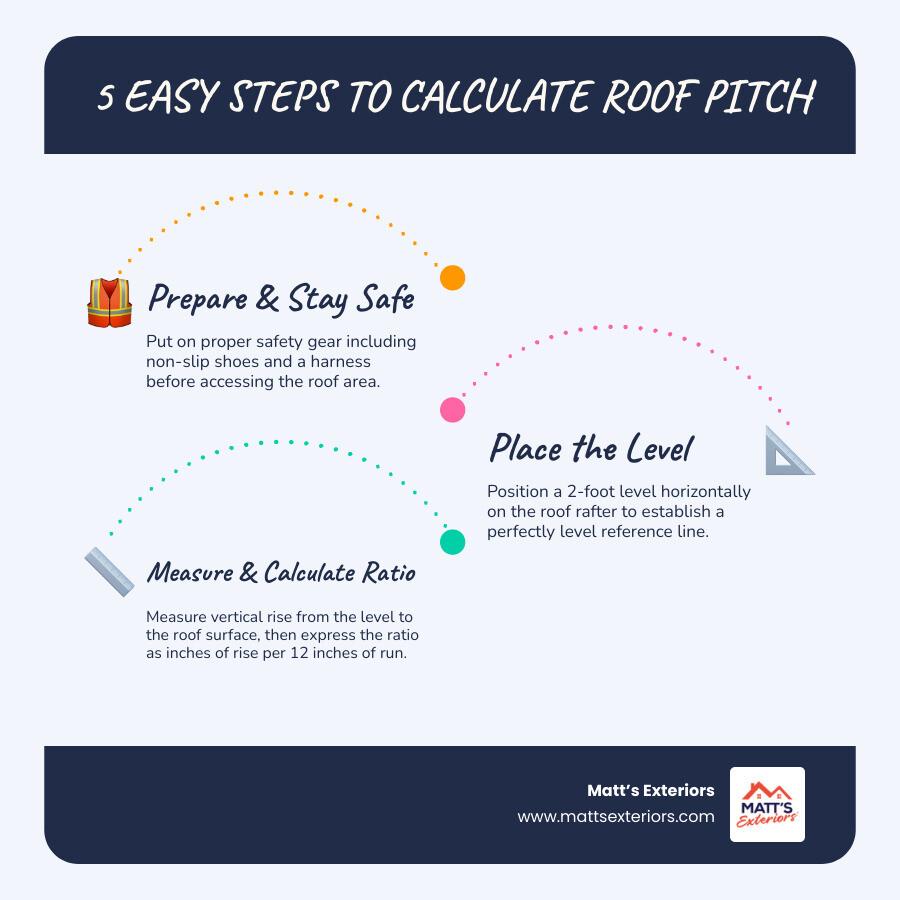
I'm Matt Lopez, owner of Matt's Exteriors, and with nearly two decades of hands-on experience installing and replacing roofs across Metro Atlanta, I've seen how matching the right roof pitch shingles to the correct installation method protects homes from Georgia's heat, humidity, and storm damage. Let's walk through exactly how to calculate your roof pitch in five simple steps — so you can make the right call for your home.
Before we grab the ladder, we need to understand the language of roofing. In the construction world, we don't usually talk about "degrees" like you did in high school geometry. Instead, we use a ratio known as "rise over run."
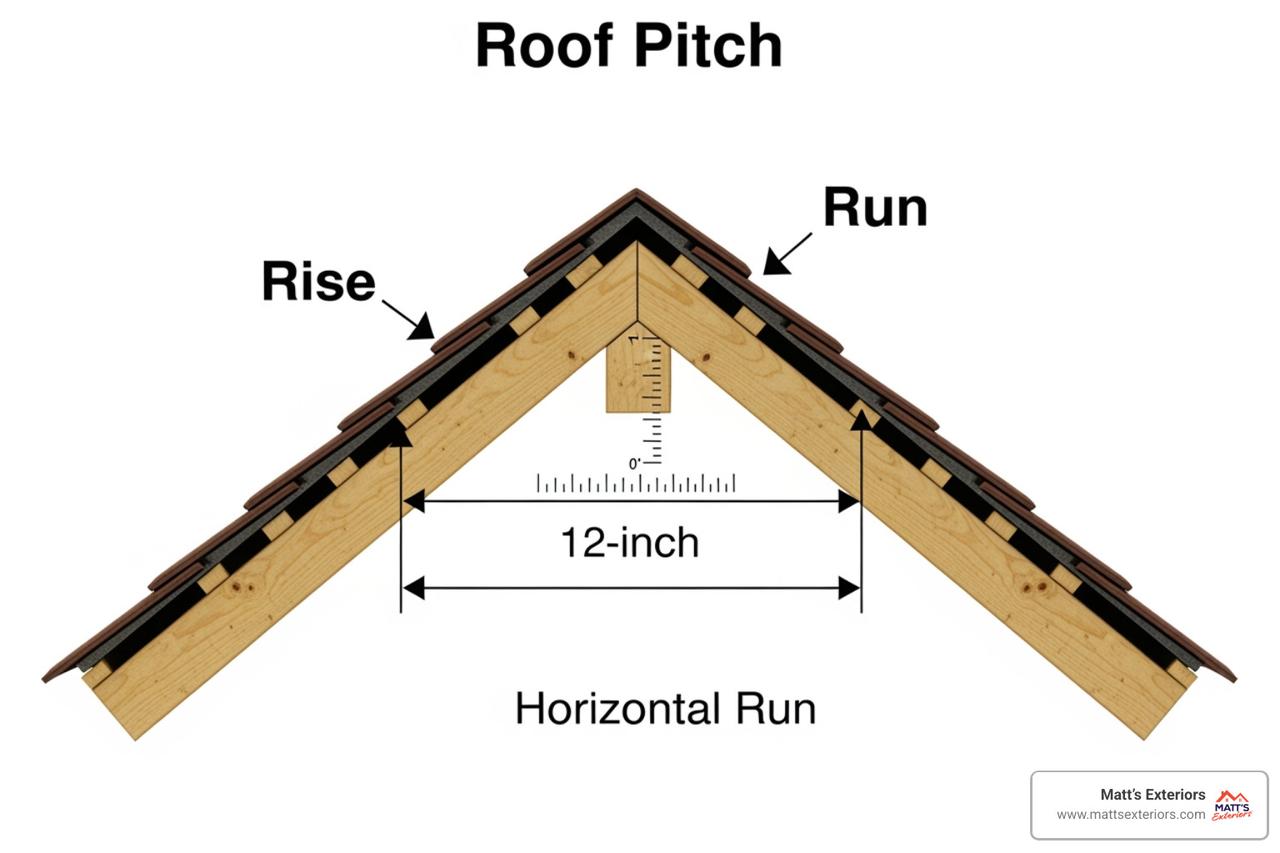
Roof pitch shingles are categorized based on how many inches the roof climbs vertically (the rise) for every 12 inches it extends horizontally (the run). This is expressed in an X:12 notation. For example, a "4:12 pitch" means for every 12 inches the roof goes out, it goes up 4 inches.
When you look at a Roof Pitch Chart - Complete Reference Guide for Roof Angles, you’ll see that this ratio determines everything from how much material we need to buy to which specific installation techniques our crews must use. Finding the Best Roof Pitch for Shingles is about balancing the architectural style of your home with the practical physics of shedding water.
Why can't you just put shingles on any roof? It all comes down to gravity. On a steep roof, water hits the shingles and immediately runs down toward the gutters. On a lower slope, water moves much more slowly. If the pitch is too shallow, wind-driven rain can actually be pushed up under the shingles, or water can "capillary" its way through the overlaps.
Properly identifying your pitch ensures:
For a deeper dive into these concepts, check out What is Roof Pitch? A Simple Guide to Understanding Sloped Roofs.
In areas like Alpharetta, Marietta, and Roswell, we see a wide variety of home styles. Most North American residential roofs fall between a 4:12 and 9:12 pitch.
Finding a Standard Roof Pitch That Actually Fits Your Home - A House in the Hills is about matching these functional ranges with your home's specific architecture.
You don't need to be a mathematician to figure this out. If you're comfortable getting on a ladder, follow these steps. If not, don't worry—we have a "no-climb" method in the next section!
If you'd rather keep your feet on the ground (which we often recommend for safety!), you can measure from the inside or use technology.
One of the biggest mistakes homeowners make is measuring the "flat" square footage of their house and thinking that's how many shingles they need. Because the roof is angled, the surface area is always larger than the footprint.
We use pitch multipliers to get the right number:
For example, a 1,500 sq ft flat footprint with a 6:12 pitch actually has about 1,677 sq ft of roof area. You can run these numbers yourself using a Roofing Calculator - Free Online Calculator | SupaCalc.
When it comes to roof pitch shingles, the rules are set by the International Building Code (IBC) and manufacturer warranties.
Feature Standard (4:12 and up) Low-Slope (2:12 to 4:12) Flat (Below 2:12) Underlayment Single layer Double layer or Self-Adhering Not allowed Shingle Type Most varieties Limited (Check warranty) Membrane only Risk Factor Low High (Water backup) Extreme (Standing water)
The absolute minimum slope for asphalt shingles is 2:12. We never, ever apply shingles to a roof flatter than that. If your roof is below 2:12, you need a different material entirely. You can find more detail on these restrictions in The Minimum Slope for Asphalt Shingles Explained.
If your roof falls in the 2:12 to 4:12 range, we can still use shingles, but we have to change our "recipe." Because water drains slower here, the risk of "capillary action"—where water creeps upward between layers—is much higher.
For these roofs, we use specialized procedures:
Our Lowest Roof Pitch for Shingles Guide explains why these steps are non-negotiable for a leak-free home.
On low-slope roof pitch shingles applications, the underlayment is actually more important than the shingles themselves. The shingles are the "aesthetic" layer, but the underlayment is the true waterproof barrier.
We typically recommend one of two methods:
For a technical breakdown of these materials, see the Minimum Slope for Composition Shingles guide.
The pitch of your roof doesn't just dictate how we install; it dictates what we install.
Choosing the Best Roofing Material for 2/12 Pitch is a critical decision we help our customers make every day.
Sometimes, shingles aren't the answer. If you have a porch or a section of your home that is truly flat (below 2:12), shingles will fail—it's just a matter of when, not if.
In these cases, we look at:
Deciding between Rolled Roofing vs Shingles: What's Best for a Low Slope Roof can save you thousands in future repair costs.
Pitch also changes how your attic breathes. Heat rises. In a steep 12:12 roof, there is a massive amount of attic space for air to circulate. In a low-pitched 3:12 roof, the "attic" might only be a few feet tall.
Low-pitch roofs are more prone to:
Keeping up with Essential Tips for Roof Maintenance is especially important for these challenging roof shapes.
The absolute minimum is 2:12. This is a strict requirement for most manufacturers (like GAF or Owens Corning) and local building codes in Georgia. Installing shingles on anything lower will void your warranty and almost certainly lead to leaks.
A 6/12 pitch has a multiplier of 1.118. If your home's footprint is 2,000 square feet, your roof surface is actually 2,236 square feet. Once you add a 10-15% waste factor for hips, valleys, and starter shingles, you’ll likely need about 25 "squares" (2,500 sq ft) of material.
Yes, but it requires a low-slope application. This includes using a double layer of underlayment or a full-coverage self-adhering leak barrier. You must also ensure the specific shingle brand is rated for that pitch, as some "heavyweight" designer shingles may not be recommended.
Calculating your roof pitch shingles is the first step toward a successful home renovation. Whether you have a steep-sloped Victorian in Atlanta or a low-sloped ranch in Fayetteville, knowing your numbers ensures you choose the right materials and the right protection.
At Matt’s Exteriors, we’ve completed over 12,000 projects since 2007. We know the local building codes in Cumming, Alpharetta, and across Metro Atlanta like the back of our hand. If you’re unsure about your roof’s pitch or notice signs of wear, don't guess—let the experts handle it.
We provide professional inspections and high-quality workmanship to ensure your roof stands up to whatever the Georgia sky throws at it. For More info about roof replacement services, reach out to us today for a trusted, family-owned perspective on your home’s exterior.