
Get Your Instant Quote Now!
Get Started
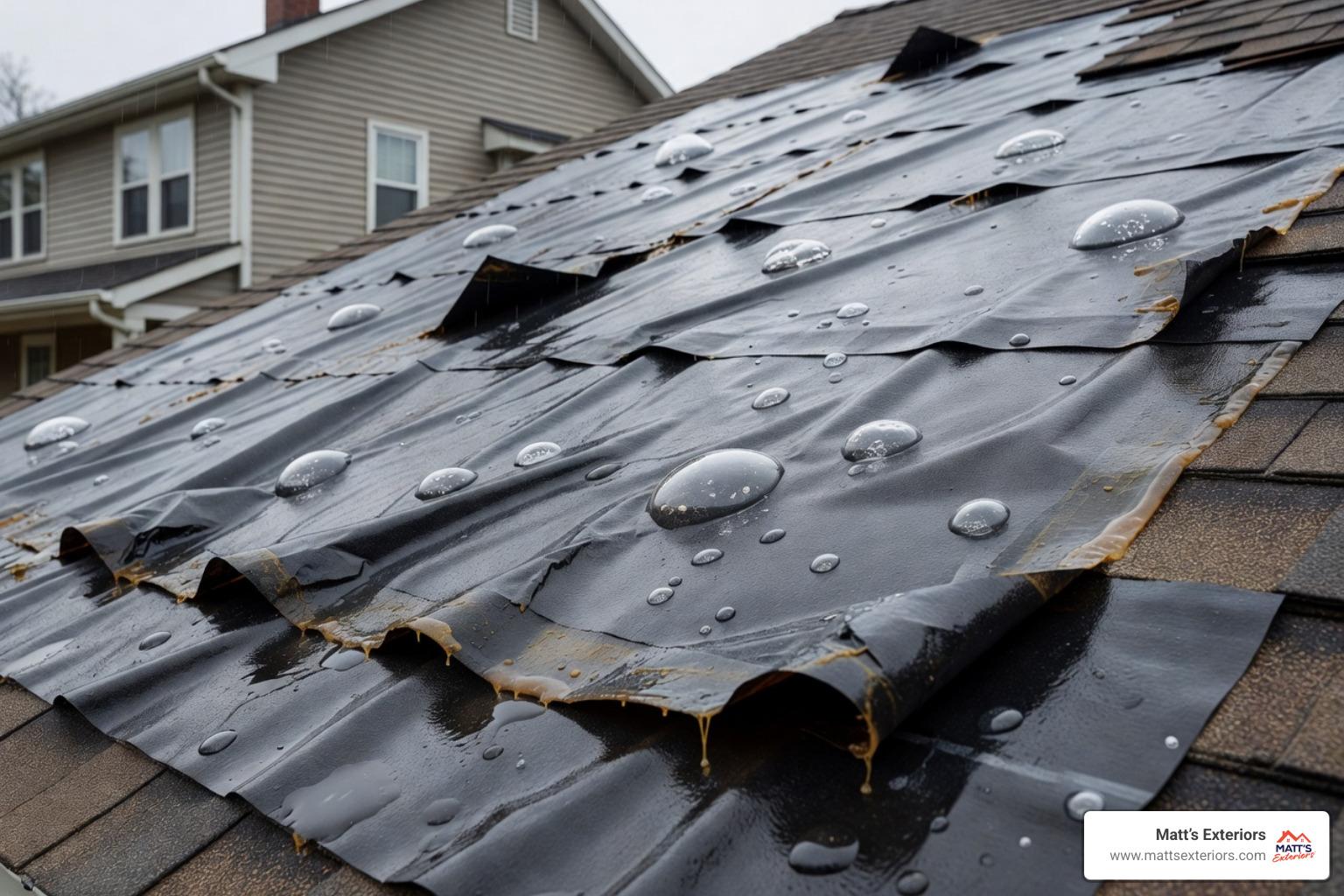
Peel and stick roofing problems are more common than most homeowners realize — and they can quietly damage your roof deck long before you notice a leak.
Here are the most common issues to watch for:
Problem What It Means Moisture trapping Improper install seals water against the deck, causing rot and mold Adhesion failure Dirty or cold surfaces prevent a proper bond, leading to lifting and leaks Temperature sensitivity Adhesive softens in summer heat and stiffens in winter, breaking the seal Removal difficulty The permanent bond can damage your roof deck during future reroofing Material incompatibility Metal roofs expand and contract, causing buckling or tearing UV degradation Exposed membrane breaks down quickly without shingle coverage Higher upfront cost At $0.40–$1.00 per sq. ft., it costs significantly more than felt or synthetic options
Peel and stick underlayment — also called ice and water shield — is made from rubberized asphalt polymers that self-adhere directly to your roof deck. It creates a watertight seal and even closes around nail holes. That sounds great on paper. But when it's installed wrong, used in the wrong climate, or paired with the wrong roofing material, it can cause serious, expensive damage.
Georgia's heat, humidity, and storm patterns make these risks even harder to ignore.
I'm Matt Lopez, founder of Matt's Exteriors, and after nearly two decades of roofing Metro Atlanta homes, I've seen how peel and stick roofing problems can turn a well-intentioned upgrade into a costly repair. Let's walk through exactly what can go wrong — and how to protect your home.
At its core, peel and stick underlayment is a premium secondary water barrier. Unlike traditional felt paper that you staple or nail down, this material features a heavy-duty adhesive backing protected by a plastic release liner. When we "peel" that liner and "stick" the membrane to your roof deck, it creates a nearly impenetrable bond.
Most of these products are made from specialized rubberized asphalt and polymer blends. This composition gives the material a "self-healing" quality. When a roofer drives a nail through it to secure your shingles, the rubberized asphalt squeezes around the nail shank, sealing the hole. This is why it is often referred to as an "ice and water shield," as it is designed to prevent water from backing up under shingles due to ice dams or wind-driven rain.
For homeowners exploring Peel and Stick Roofing For Flat Roofs And Beyond 729014, it is important to understand that this isn't just a "nicer" version of felt. It is a high-performance membrane that serves as the last line of defense for your home's structural integrity. However, that high performance relies entirely on a flawless installation.
While we often recommend these products for valleys, eaves, and penetrations, a full-roof application can introduce a variety of peel and stick roofing problems. In our experience serving areas from Marietta to Peachtree City, we’ve found that most failures stem from environmental factors or human error during the build.
According to research on Peel and Stick Roofing Problems: Causes, Prevention, and Remedies – Collingwood Roof Repair, many of these issues are preventable but require a level of precision that "budget" contractors often skip.
One of the most dangerous peel and stick roofing problems is its lack of breathability. Most peel and stick products act as a total vapor barrier. While this keeps rain out, it also keeps internal moisture in.
If your home has poor attic ventilation, humidity from your bathrooms and kitchen rises into the attic. In a traditional roof, some of this vapor can escape through the wood and felt. With a full-deck peel and stick application, that moisture hits the bottom of the cold roof deck and turns into condensation. Because it can't escape through the membrane, it soaks back into the plywood.
Over time, this leads to mold growth and structural rot. We often see this during a Flat Roof Repair where the owner didn't realize their "waterproof" roof was actually rotting from the inside out. Proper attic ventilation is non-negotiable when using these products.
The adhesive on these rolls is incredibly picky about the weather. In the roofing world, we call this the "installation window."
As noted in the guide on 5 Problems With Peel and Stick Roofing Underlayment, extreme heat can also lead to VOC (volatile organic compound) loss. When the oils in the asphalt evaporate too quickly due to heat, the membrane becomes brittle and loses its ability to seal around nails.
This is the problem that catches homeowners off guard 20 years down the line. Because peel and stick is designed to bond permanently to the plywood, it is notoriously difficult to remove.
When it comes time for your next roof replacement, the old underlayment often won't peel off. Instead, it tears away in tiny chunks or takes the top layer of the plywood deck with it. This can lead to:
According to Peel and Stick Roof Underlayment Problems: Warning Signs 2026, many professionals now suggest "overlay" options where possible, but if the deck underneath is damaged, you're looking at a full structural tear-off.
Choosing the right material depends on your budget and your roof's specific needs. Here is how they stack up:
Feature Traditional Felt Synthetic Underlayment Peel and Stick Cost (per sq. ft.) $0.05 – $0.50 $0.17 – $0.55 $0.40 – $1.00 Lifespan 12 – 20 Years 25 – 50 Years 25 – 40 Years Water Resistance Moderate High Superior Tear Resistance Low Very High High Breathability Yes Some (if rated) No (Vapor Barrier)
While felt is the cheapest, it wrinkles when it gets wet and tears easily. Synthetic underlayment, made from woven polypropylene, is the "middle ground" favorite for many Georgia homes because it's tough and cost-effective. However, for low-slope areas, you have to look at Rolled Roofing Vs Shingles Whats Best For A Low Slope Roof to decide if a full adhesive membrane is required for safety.
The average cost of a single roll of peel and stick is around $150. While that sounds manageable, the "hidden" costs of peel and stick roofing problems can be staggering.
If you experience failure, here are the typical repair estimates:
While a high-quality install might lower your insurance premiums by up to 25% in some hurricane-prone zones, those savings disappear quickly if you have to perform an Asphalt Shingle Roof Repair because of moisture trapped under the membrane.
Not every roofing material plays nice with peel and stick.
To avoid peel and stick roofing problems, the installation must be handled with surgical precision. At Matt's Exteriors, we follow a strict protocol to ensure these membranes actually protect your home rather than harm it.
If you're already seeing signs of failure, our Roof Repair Services can help diagnose whether the membrane can be saved or if a replacement is necessary.
Absolutely not. This is one of the biggest mistakes we see. Peel and stick underlayment must bond directly to the clean wood deck. If you stick it to old felt, it will only be as strong as the staples holding that felt down. It won't seal around nails, and it won't provide the wind-uplift resistance you're paying for. If you're looking at Asphalt Roll Roofing Menards or similar DIY products, always read the fine print: direct deck adhesion is mandatory.
It can if the wrong product is used. Standard rubberized asphalt can soften in extreme heat, and some homeowners worry this "melts" the shingles. While it doesn't usually melt the shingle itself, it can bond the shingle so firmly to the underlayment that they become a single, inseparable layer. Using a granulated-surface peel and stick or a high-temp membrane (like those found at 90 Lb Roll Roofing Home Depot) can help mitigate this heat transfer.
In Metro Atlanta, we deal with intense humidity and the occasional remnants of tropical storms. For most homes, we recommend a hybrid approach: use peel and stick in high-risk areas like valleys, chimneys, and the bottom three feet of the roof (the eaves), and use high-quality synthetic underlayment for the rest. However, your Best Roof Pitch For Shingles will dictate the final choice. If you have a very low-slope roof, the extra cost of a full peel and stick system is a necessary investment for leak prevention.
Peel and stick roofing is a powerful tool in a roofer's arsenal, but it isn't a "magic bullet." From moisture trapping and deck rot to the nightmare of future removal, the risks are real. In the Metro Atlanta climate—where the sun is brutal and the rain is heavy—these peel and stick roofing problems can escalate quickly if your contractor cuts corners.
At Matt’s Exteriors, we believe in doing the job right the first time. We've completed over 12,000 projects since 2007, and we know exactly which materials work best for the unique weather in Alpharetta, Marietta, and throughout Metro Atlanta. Don't leave your home's protection to chance or a "sticky" shortcut.
If you're worried about your current underlayment or planning a new project, let us provide a professional inspection. Schedule Your Roof Replacement with a team that understands the "sticky truth" and knows how to keep your home dry for decades to come.